

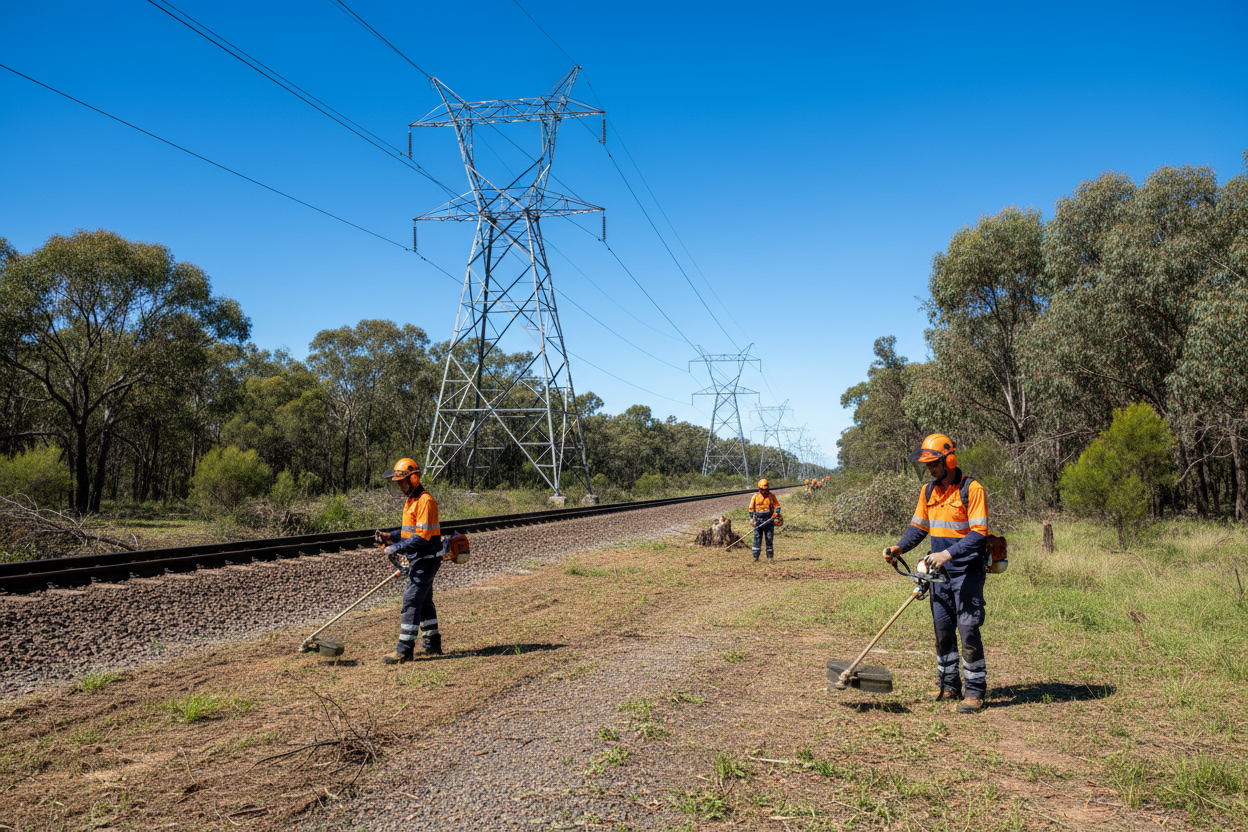
Managing Risk as an Opportunity in Vegetation Management | Integrated Vegetation Management Series 2026 Article 3
In the first article of this series, we explored why traditional reactive vegetation management models are struggling to deliver stable outcomes. In the second article we examined how proactive program design changes the way vegetation outcomes are achieved.
This article focuses on risk, and why it represents one of the greatest missed opportunities in vegetation management today.
Across most linear infrastructure portfolios, vegetation risk is already being outsourced. Contractors carry day to day exposure, access challenges and delivery risk. However, asset owners and asset managers continue to carry consequence risk when outcomes fail, whether through safety incidents, service disruption, regulatory scrutiny or reputational impact.
This misalignment is rarely acknowledged explicitly.
Traditional prescriptive contracts tend to specify activity without clearly linking it to risk reduction. When conditions change or outcomes deteriorate, escalation becomes the default response. Frequency increases. Exposure increases. Cost volatility increases. Yet risk remains poorly defined and difficult to defend.
Integrated Vegetation Management takes a different approach.
Rather than treating risk as something to absorb, IVM treats risk as something to design around. Outcomes are defined upfront. Condition, performance and risk triggers are agreed in advance. Intervention is tied to measured thresholds rather than fixed schedules. Evidence is captured systematically to support decisions.
This shift changes the commercial and operational dynamic.
For asset owners, risk becomes more predictable and defensible. Decisions can be linked directly to agreed triggers and measured conditions rather than reactive judgement calls. For asset managers, IVM provides a framework that supports governance, assurance and audit requirements while reducing volatility. For service providers and contractors, risk becomes something that can be managed through capability, planning and discipline rather than absorbed through volume.
Importantly, managing risk deliberately creates opportunity.
Organisations that understand their vegetation risk profile are better able to prioritise effort, defer unnecessary intervention, and allocate resources where they have the greatest impact. Contractors that can demonstrate the ability to manage risk through program design and evidence gain a clear competitive advantage over those competing on activity alone.
This does not require a wholesale reset of existing arrangements. Many organisations transition through hybrid models, retaining baseline activities while introducing outcome measures and risk triggers in higher consequence areas. This allows confidence to build without increasing exposure.
The key shift is mindset. Risk is no longer something to be reacted to after failure. It becomes something that is understood, priced and reduced through design.
In the next article in this series, we will explore how this approach translates into contract structures, governance models and transition pathways that allow organisations to move toward outcome based IVM programs without losing control.
If you are managing vegetation across assets where risk is increasing faster than confidence, this is the point where Integrated Vegetation Management moves from concept to practical advantage.

Additional content
VIEW GWS' ADDITIONAL CONTENT TO LEARN MORE ABOUT THE WEED INDUSTRY
Selecting Herbicides Within an Integrated Vegetation Management Program
Effective herbicide selection begins long before a product is chosen. Within an Integrated Vegetation Management (IVM) program, herbicides are selected to support clearly defined management objecti...
Read more
Integrated Vegetation Management: Managing Outcomes, Not Treatments
A vegetation program is not defined by how many times a crew sprays or mows. It is defined by whether the asset is safe, functional and being managed to an agreed standard over time. Integrated Veg...
Read more
Supply disruption is a chance to review, plan and rotate.
When a major product becomes unavailable, it creates an important moment for the industry to pause, review and adapt. The recent supply disruption affecting a key industrial residual herbicide is a...
Read more