

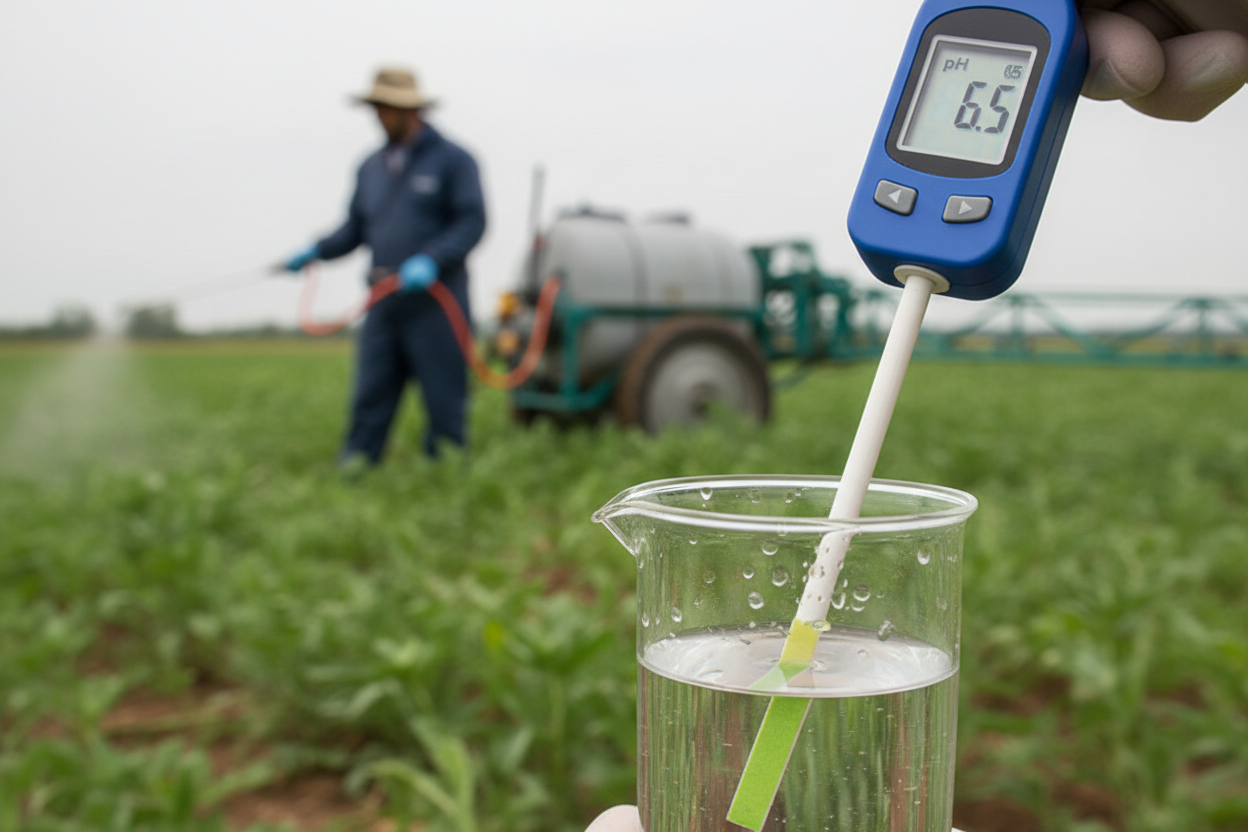
Town Water pH in Australia and Its Impact on Weak Acid Herbicides
Australian vegetation managers often assume that town water is neutral and therefore suitable for spraying without adjustment. In practice, most municipal and regional water supplies are treated to be slightly alkaline to protect pipes and infrastructure. This has direct and often underestimated consequences for the performance of weak acid herbicides.
This article expands on our earlier discussion of water pH and herbicide performance by focusing specifically on Australian town water characteristics, why pH matters at a chemical level, and how to manage spray water to achieve consistent, label aligned results in the field.
Typical Town Water pH in Australia
Across Australia, treated town water generally sits above neutral. While values vary by region and season, most supplies fall within a relatively narrow band.
• Typical range is 6.7 to 7.9 pH
• Regional and inland supplies are often at the upper end of this range
• Some schemes regularly exceed 8.0 pH, particularly where hardness is also elevated
This means that many spray operations are unknowingly starting with water that is already sub optimal for weak acid herbicides before product is added to the tank.
Why Weak Acid Herbicides Are Sensitive to pH
Weak acid herbicides such as glyphosate, 2,4-D, MCPA, dicamba, picloram and triclopyr exist in equilibrium between two chemical forms when dissolved in water.
1. Non ionised form which is uncharged and readily absorbed through leaf cuticles
2. Ionised form which is charged and poorly absorbed by plant tissue
The balance between these forms is controlled by pH. As spray water becomes more alkaline, a greater proportion of the herbicide shifts into the ionised form. This directly reduces uptake, slows translocation, and lowers overall control.
In practical terms, the herbicide does not stop working. It simply works less efficiently, resulting in slower knockdown, reduced kill rates, and greater variability across sites.
Spray Solution pH and Herbicide Uptake
For most weak acid herbicides, uptake is maximised under mildly acidic conditions.
• Optimal spray solution pH is 5.5 to 6.5
• Below this range, herbicides remain largely non ionised
• Above 7.0 pH, ionisation increases and uptake declines
Because most Australian town water starts close to or above 7.0 pH, adjustment is often required to reach this optimal window.
Relative Herbicide Performance at Different pH Levels
The effect of pH is not uniform across products or formulations. The table below illustrates approximate relative efficacy of common weak acid herbicides at increasing spray water pH, assuming 100 percent performance at pH 6.5 or below.

Several practical patterns emerge from this data. Glyphosate is highly sensitive to alkaline water and shows rapid performance loss above 8.0 pH. Amine formulations of phenoxy and pyridine herbicides decline steadily as pH rises. Ester formulations are more tolerant but still perform best under mildly acidic conditions. Dicamba and picloram show progressive uptake reduction as alkalinity increases.
Water Hardness and pH Interaction
In many Australian supplies, elevated pH coincides with moderate to high hardness. Calcium, magnesium and iron cations can bind to weak acid herbicides, particularly glyphosate, further reducing availability for plant uptake.
Lowering spray solution pH helps in two ways. It shifts the herbicide into the non ionised form and it reduces cation binding, improving biological availability. This is why acidification or buffering can deliver noticeable gains even when weeds appear susceptible and rates are correct.
Practical Management for Australian Spray Programs
Consistent performance requires treating water as an input that must be managed, not assumed.
- Measure spray water pH before adding any herbicide
- If pH exceeds approximately 7.0 to 7.2, adjust using a suitable acidifier or buffering adjuvant
- Confirm final spray solution pH is within the 5.5 to 6.5 target range
- Add herbicides only after water has been adjusted
- Include surfactants or adjuvants after pH correction, unless the product label specifies otherwise
These steps are simple, low cost, and often deliver greater gains than increasing application rates or changing products.
Closing Perspective
Town water pH in Australia is rarely ideal for weak acid herbicides by default. Without adjustment, applicators may be giving away a significant proportion of potential efficacy on every spray pass. Measuring and managing spray water pH is one of the most reliable ways to improve consistency, reduce retreatment, and ensure that herbicides perform as intended under Australian conditions.
This is not about chasing perfection. It is about removing a known and controllable limitation from the system so that chemistry, timing and application technique can do their job properly.

Additional content
VIEW GWS' ADDITIONAL CONTENT TO LEARN MORE ABOUT THE WEED INDUSTRY
Selecting Herbicides Within an Integrated Vegetation Management Program
Effective herbicide selection begins long before a product is chosen. Within an Integrated Vegetation Management (IVM) program, herbicides are selected to support clearly defined management objecti...
Read more
Integrated Vegetation Management: Managing Outcomes, Not Treatments
A vegetation program is not defined by how many times a crew sprays or mows. It is defined by whether the asset is safe, functional and being managed to an agreed standard over time. Integrated Veg...
Read more
Supply disruption is a chance to review, plan and rotate.
When a major product becomes unavailable, it creates an important moment for the industry to pause, review and adapt. The recent supply disruption affecting a key industrial residual herbicide is a...
Read more