

Water Quality and Tank Mixing: Why Formulation Matters
Two herbicides may contain exactly the same active ingredient yet produce noticeably different field results. While the active ingredient provides the herbicidal activity, the formulation determines how that active ingredient behaves in the spray tank, on the leaf surface and within the plant. Understanding formulation, water quality and correct mixing practices is therefore essential for achieving consistent herbicide performance.
The active ingredient is only one component of a modern herbicide. Formulations also contain carefully selected surfactants, dispersants, solvents, buffers and other co formulants that improve mixing, stability, plant uptake, rainfastness and product handling. These components are often the result of significant research and development and can have a substantial influence on field performance.
Water quality is one of the most overlooked factors affecting herbicide efficacy. Hard water containing elevated calcium or magnesium can bind with herbicides such as glyphosate, reducing the amount of active ingredient available for plant uptake. High turbidity may absorb herbicide molecules onto suspended clay or organic matter, while unsuitable pH or elevated dissolved salts can further reduce product performance or stability. Testing water quality before spraying should become a routine part of spray planning rather than a response to poor results.
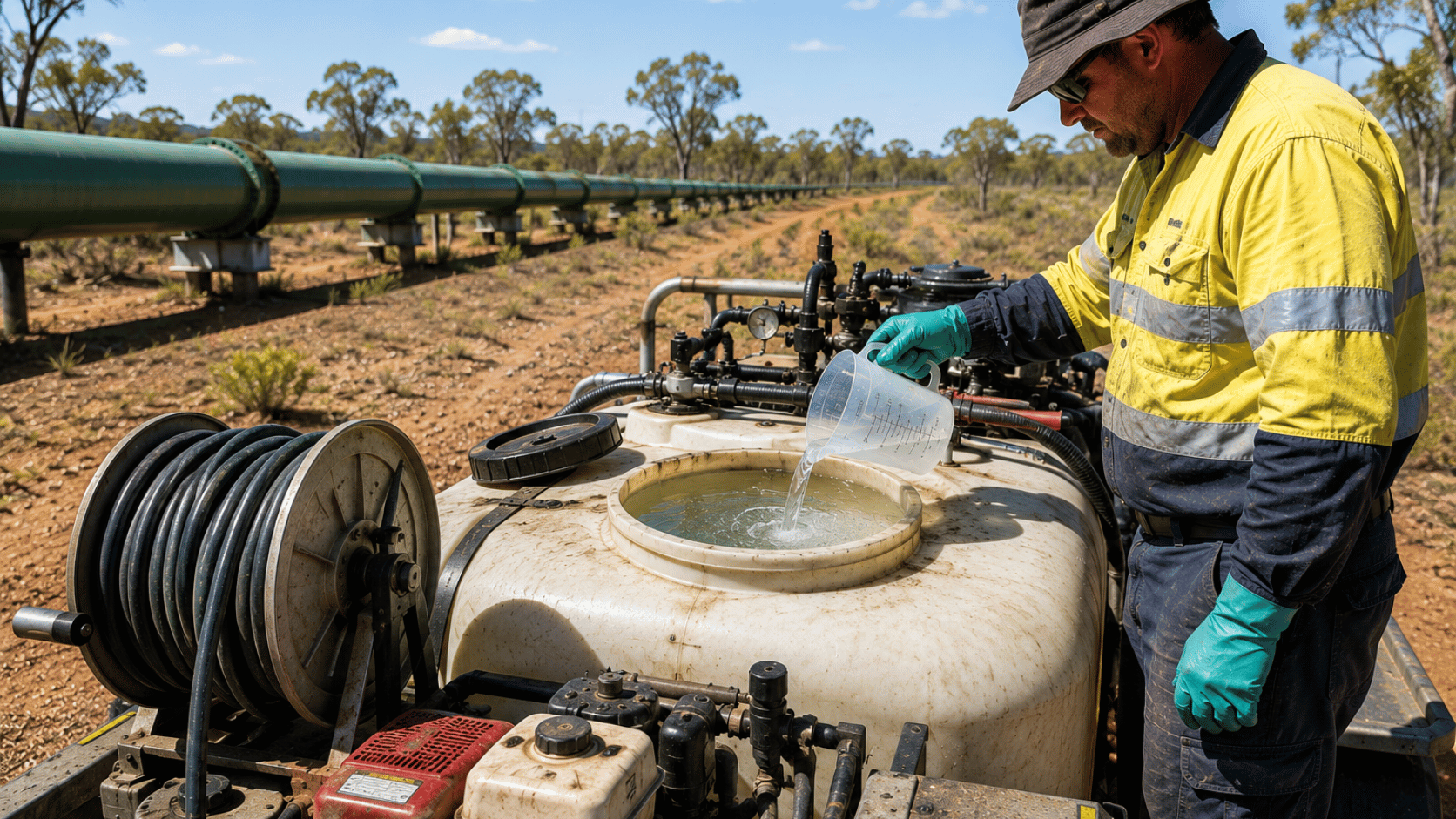
Correct tank mixing is equally important. Products should always be added in the sequence recommended on the product label to ensure they disperse properly and remain stable throughout application. As a general guide, begin with clean water, add any required water conditioners, followed by water dispersible granules, suspension concentrates, emulsifiable concentrates, adjuvants or surfactants, before topping up the remaining water. Maintaining adequate agitation throughout the mixing process helps ensure a uniform spray solution.
Where multiple products are being combined, compatibility should never be assumed. A simple jar test using the intended water source allows operators to identify potential issues before preparing a full spray tank. Products should be added in the intended mixing sequence, thoroughly mixed and observed for layering, precipitation, excessive foaming or settling. A few minutes spent conducting a jar test can prevent costly equipment blockages, downtime and ineffective applications.
Aquatic applications require particular attention to formulation selection. Regulatory approvals apply to the complete formulated product rather than simply the active ingredient. Two herbicides containing identical active ingredients may have entirely different aquatic approvals because of differences in their co-formulants. Products should never be assumed to be interchangeable based solely on the active ingredient listed on the label.
Successful herbicide application depends on much more than selecting the correct chemistry. Water quality, formulation technology, mixing procedures and sound application practices all contribute to reliable, repeatable field performance.
Understanding formulation is an important part of professional spray application. By considering the entire spray system rather than focusing only on the active ingredient, operators can improve herbicide performance, reduce avoidable failures and support more effective vegetation management programs.
Tank Mixing and Application Preparation Checklist
Successful herbicide performance depends on more than selecting the right product. Water quality, formulation, compatibility and correct application practices all influence field performance. This checklist highlights the key preparation steps that should be completed before spraying. Always follow the product label and your organisation's operating procedures.
Water Quality
☐ Test the spray water source for pH, hardness and turbidity where appropriate.
☐ Add any required water conditioners before herbicides, where specified by the product label.
Product Selection and Compatibility
☐ Confirm the selected products are suitable for the target vegetation and application.
☐ Check product compatibility and conduct a jar test where compatibility is uncertain or multiple products are being combined.
Tank Mixing
☐ Follow the product label and recommended mixing sequence.
☐ Maintain adequate agitation throughout the mixing and filling process.
Application Equipment
☐ Ensure the spray unit is correctly calibrated.
☐ Select nozzles that provide the appropriate droplet spectrum for the target and application method.
☐ Check filters, hoses, pressure and equipment condition before spraying.
Application Conditions
☐ Confirm weather conditions are suitable to minimise drift and maximise herbicide performance.
☐ Record the products used, application rates, weather conditions and other relevant spray details.

Additional content
VIEW GWS' ADDITIONAL CONTENT TO LEARN MORE ABOUT THE WEED INDUSTRY

Selecting Herbicides Within an Integrated Vegetation Management Program
Effective herbicide selection begins long before a product is chosen. Within an Integrated Vegetation Management (IVM) program, herbicides are selected to support clearly defined management objecti...
Read more
Integrated Vegetation Management: Managing Outcomes, Not Treatments
A vegetation program is not defined by how many times a crew sprays or mows. It is defined by whether the asset is safe, functional and being managed to an agreed standard over time. Integrated Veg...
Read more
Supply disruption is a chance to review, plan and rotate.
When a major product becomes unavailable, it creates an important moment for the industry to pause, review and adapt. The recent supply disruption affecting a key industrial residual herbicide is a...
Read more