

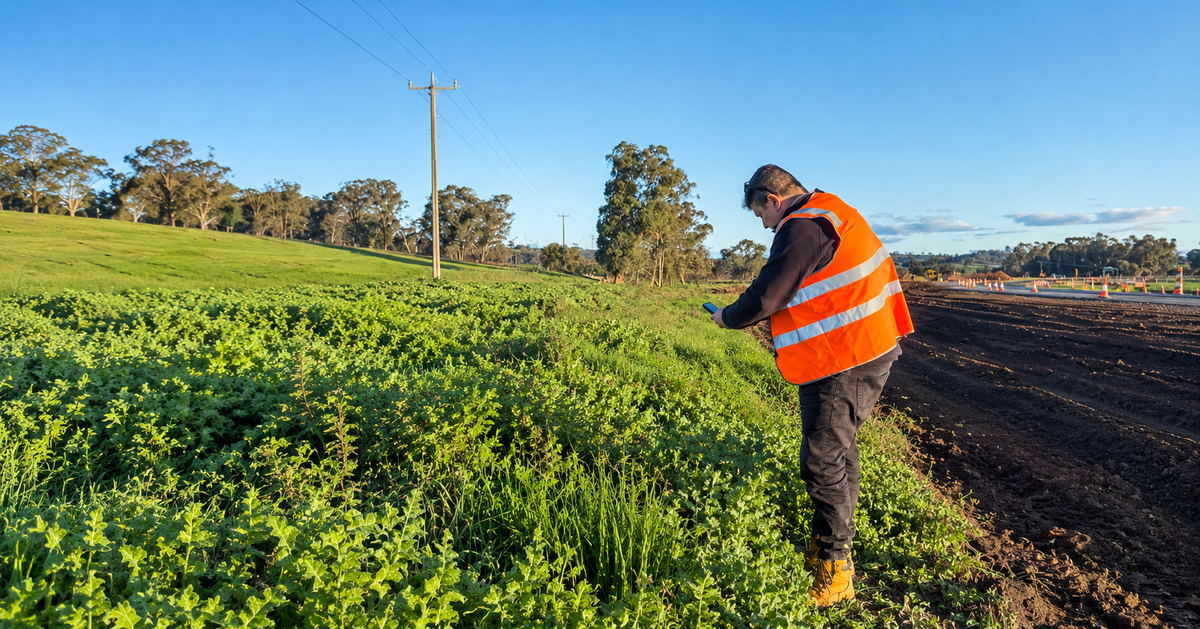
Selecting Herbicides Within an Integrated Vegetation Management Program
Effective herbicide selection begins long before a product is chosen. Within an Integrated Vegetation Management (IVM) program, herbicides are selected to support clearly defined management objectives rather than dictate them. This structured approach improves vegetation outcomes, reduces unnecessary herbicide use and supports sustainable asset management.
The first step is to define the desired management outcome. Objectives may include maintaining safe sight lines, protecting infrastructure, reducing bushfire risk, conserving native vegetation, controlling declared weeds or improving the appearance and functionality of public assets. Once the objective is clear, every subsequent management decision can be assessed against that outcome.
A thorough site assessment is then required. Factors such as target weed species, weed density, growth stage, desirable vegetation, soil type, proximity to waterways, environmental values, seasonal conditions, site access and operational constraints all influence which control options are appropriate. Understanding the site ensures management decisions are based on evidence rather than assumptions.
Integrated Vegetation Management considers the full range of available control techniques. Chemical control may be combined with mowing, slashing, hand removal, revegetation, grazing or other cultural and environmental practices to achieve the most effective long term result. Herbicides should be applied where they provide the greatest operational and environmental benefit within the overall program.
When selecting a herbicide, vegetation managers should consider target weeds, herbicide mode of action, selectivity, pre emergent activity where appropriate, application method, environmental approvals and the site's resistance history. All products must be used in accordance with the approved label and any applicable permit requirements.
In many situations the most effective program combines knockdown herbicides to control existing vegetation with pre emergent herbicides that suppress future germination. Selecting the appropriate combination depends on operational objectives, environmental conditions and label directions rather than adopting a standard approach across every site.
Resistance management should also form part of every herbicide selection decision. Repeated reliance on a single herbicide group increases selection pressure on weed populations. Rotating effective modes of action, integrating non chemical controls, monitoring treatment outcomes and preventing survivors from producing seed all contribute to preserving herbicide effectiveness.
Integrated Vegetation Management is an adaptive process. Programs should be reviewed following treatment, outcomes recorded and future decisions adjusted according to weed response, seasonal conditions and operational experience. Continuous improvement delivers better long term vegetation management than repeating the same program regardless of results.
Selecting the right herbicide is therefore not simply a product decision. It is the outcome of understanding management objectives, evaluating site conditions and integrating the most appropriate control methods to achieve sustainable vegetation outcomes.
Herbicide Selection Checklist
Define the management objective before selecting products.
Herbicide Selection Gate
- Define the required asset outcome.
- Confirm the target species, growth stage and site constraints.
- Compare chemical and non-chemical controls.
- Confirm the proposed herbicide use is consistent with the approved label and any applicable permit.
- Review selectivity, activity, application method, herbicide group and resistance history.
- Define how and when treatment performance will be assessed.
Greenway decision rule: Select the treatment for the asset outcome first. Select the herbicide only after herbicide has earned its place in that treatment strategy.
Assess site conditions and environmental constraints.
Integrate chemical and non chemical control methods.
Select herbicides based on target weeds, approvals and herbicide group.
Consider resistance risk and rotate effective modes of action.
Monitor outcomes and adapt future programs.
Use in practice
Use this framework with current product labels, applicable permits, organisational procedures and site-specific risk controls. Record the decision, the treatment and the result so the next intervention can be based on evidence rather than habit.

%20program,%20herbicides%20are%20selected%20to%20support%20clearly%20defined%20management%20objecti...)
Additional content
VIEW GWS' ADDITIONAL CONTENT TO LEARN MORE ABOUT THE WEED INDUSTRY

Understanding Herbicide Modes of Action
Selecting a herbicide involves more than identifying the target weed. To achieve reliable long term vegetation outcomes, vegetation managers must also understand how herbicides work within the plan...
Read more
Developing an Annual Vegetation Management Plan for Infrastructure Assets
An Annual Vegetation Management Plan provides the framework for managing infrastructure assets safely, efficiently and sustainably throughout the year. Rather than responding to issues as they aris...
Read moreSelecting Herbicides Within an Integrated Vegetation Management Program
Effective herbicide selection begins long before a product is chosen. Within an Integrated Vegetation Management (IVM) program, herbicides are selected to support clearly defined management objecti...
Read more