

Herbicide Resistance: Protecting the Tools We Still Have
Herbicide resistance is usually noticed when something stops working. A treatment that once delivered reliable control begins leaving survivors and attention quickly turns to what product should be used next.
But resistance is not fundamentally a product problem. It is a population management problem.
Every time a weed population is exposed to an effective herbicide, the treatment creates selection pressure. Susceptible plants are removed, while plants capable of surviving have an opportunity to reproduce. When the same pressure is applied repeatedly, those survivors can contribute an increasing proportion of the next generation and, over time, the population changes.
This is why resistance management has moved well beyond simply protecting glyphosate. The challenge is to protect the entire herbicide toolbox by reducing repeated dependence on any single control pressure.

A survivor is not automatically resistant. Repeated survival from a treatment that should normally work is a reason to investigate.
Research presented at the Australasian Weeds Conference reinforced this through several very different weeds. Johnson grass, feathertop Rhodes grass and annual ryegrass each tell a different part of the resistance story, but together they raise an important question for vegetation managers:
What is actually controlling the weed population, and what is being allowed to survive?
Resistance starts with what survives
High levels of control can disguise a developing problem. A treatment may remove most of a population and still create significant selection pressure if the same small group of plants repeatedly survives and reproduces.
This makes post treatment inspection an important part of resistance management. The focus needs to extend beyond what was treated to what survived, why it survived and whether those plants are being allowed to reproduce.
The word effective is critical. Several herbicides in a tank do not automatically provide several useful resistance management pressures. If only 1 component is providing meaningful control of the target weed, most of the selection pressure may still be coming from that 1 mode of action. Likewise, changing product names does not necessarily change the biological pressure being applied to the population.

Resistance develops through selection. Plants that repeatedly survive treatment can make up a greater proportion of future populations.
Johnson grass: when the same species becomes a different control problem
Johnson grass, Sorghum halepense, demonstrates why resistance needs to be considered at population level rather than simply by species.
Research from central Queensland compared populations collected from different locations following concerns about glyphosate performance. Some remained readily controlled, while others were substantially less sensitive. One population collected from a sorghum field was approximately 4.8 times less sensitive to glyphosate than the susceptible population used for comparison.
The research also demonstrated the importance of timing. Larger resistant plants became more difficult to control, increasing the value of intervening while weeds were smaller and more susceptible.
Testing alternative treatments provided another important lesson. Simply replacing a familiar herbicide with another broad spectrum option did not guarantee control. Under the research conditions, one likely alternative still left substantial survival, while other genuinely different treatments produced much stronger results.
For vegetation managers, the implication is clear. Alternative chemistry only contributes to resistance management when it provides effective control of the population being treated. Different chemistry is not necessarily effective chemistry.

Johnson grass demonstrates why populations of the same species can respond very differently to the same herbicide.
Feathertop Rhodes grass: detect change before widespread failure
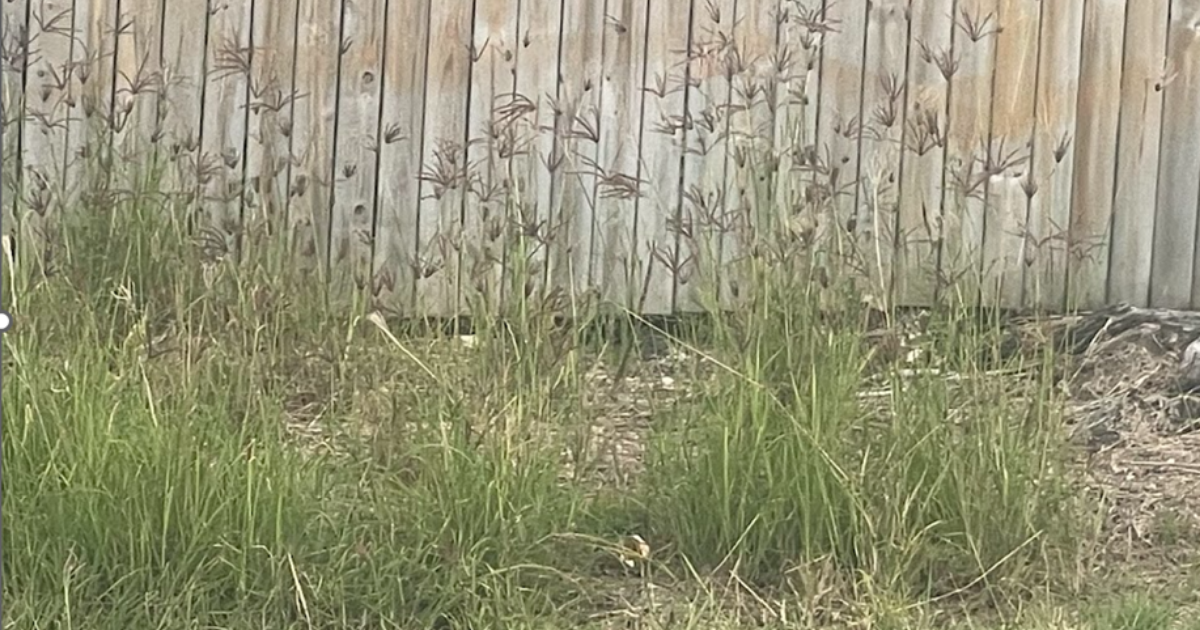
Feathertop Rhodes grass, Chloris virgata, provides a different lesson. Successive resistance surveys across northern Australia have tracked populations over time rather than waiting for widespread control failure before investigating.
Glyphosate resistance has become widespread in surveyed populations, but the broader value of this work is the continuing assessment of susceptibility to other herbicides. Establishing benchmarks allows changes in treatment response to be identified before another useful option becomes heavily compromised.
That is resistance stewardship rather than resistance reaction, and the same principle can be applied to infrastructure vegetation management without conducting formal resistance surveys.
Most vegetation programs record what was sprayed, where and when. Far fewer systematically record what survived. Yet survivor information may provide one of the earliest warnings that treatment performance is changing.
A record showing that 3 treatments were completed tells us what work occurred. Knowing that the same species survived all 3 tells us considerably more about the performance of the program.

Monitoring survivors can reveal changing treatment response before widespread failure becomes obvious.
Annual ryegrass: new chemistry enters an old population
Annual ryegrass, Lolium rigidum, adds another dimension to the resistance challenge.
Research from the University of Adelaide has identified resistance to relatively new Group 13 pre emergent chemistry in annual ryegrass populations that also show substantial resistance to older Group 15 chemistry. The biological relationship between those resistance patterns is still being investigated, so it would be inappropriate to assume that resistance to one group simply caused resistance to the other.
The management implication is more straightforward. New chemistry does not enter a new weed population. It enters a population carrying the selection history created by everything that has been applied before it.
Stewardship therefore needs to begin when an effective new tool is introduced, not after resistance appears. If a highly effective herbicide simply becomes the next treatment relied upon repeatedly, the selection cycle starts again.

New herbicides are introduced into weed populations that may already carry years of selection history.
From herbicide rotation to resistance management
Together, these examples show why resistance management needs to extend beyond simply rotating herbicide groups. The objective is to reduce the management burden placed on any single tactic.
Depending on the weed, site and operational environment, this can include different effective modes of action, targeting weeds when they are most susceptible, incorporating residual or pre emergent strategies, reducing seed return, managing recruitment and introducing mechanical or other non chemical interventions where practical.
Integrated weed management sometimes describes this as applying “many little hammers”. The strength comes from combining enough effective pressures that the vegetation program is not dependent on one treatment continuing to work indefinitely.
This also changes how treatment success should be measured. Percentage kill remains important, but the longer term question is whether the plants capable of repeatedly surviving treatment are being allowed to reproduce and influence the next population.
What this means for infrastructure vegetation management
Much of the formal research into herbicide resistance comes from agriculture, but the underlying selection process is directly relevant to infrastructure.
Roadsides, rail corridors, utilities, solar farms, industrial sites and hardstands can expose the same weed populations to similar vegetation management programs year after year. Where a herbicide continues to provide reliable control, there is an understandable tendency to keep using it. That operational consistency can also create sustained selection pressure.
This does not mean every control failure should be labelled resistance. Poor weed identification, inappropriate growth stage, water quality, mixing, calibration, coverage, weather, application timing and herbicide selection can all produce survivors and should be investigated before resistance is assumed.
The important distinction is repeated survival.
When the same weed continues to survive a treatment that should normally provide effective control, simply repeating the application is unlikely to improve the long term outcome. A stronger program uses that survival as information, investigates the cause, records what occurred, adjusts the treatment strategy where necessary and monitors the population through subsequent interventions.

Resistance management is an ongoing cycle of diagnosis, effective treatment, survivor management and monitoring.
Protecting what still works
The research points to a consistent message for vegetation managers.
Johnson grass demonstrates that different populations of the same species can become very different control problems. Feathertop Rhodes grass shows the value of detecting changing susceptibility before widespread failure occurs. Annual ryegrass demonstrates why introducing new chemistry does not erase the selection history already present within a population.
The practical response is not to continually search for the next herbicide. It is to manage the population more deliberately.
Know the treatment history, inspect the result and understand what survived. Investigate repeated failure early. Use alternative chemistry because it is genuinely effective against the target population, not simply because it is different. Where practical, combine chemical control with other pressures that reduce recruitment and seed return.
Most importantly, avoid turning the next highly effective herbicide into the next treatment used repeatedly everywhere.
Herbicide resistance is ultimately a consequence of how weed populations are managed over time. The best time to protect an effective herbicide is while it still works.

Additional content
VIEW GWS' ADDITIONAL CONTENT TO LEARN MORE ABOUT THE WEED INDUSTRY
Selecting Herbicides Within an Integrated Vegetation Management Program
Effective herbicide selection begins long before a product is chosen. Within an Integrated Vegetation Management (IVM) program, herbicides are selected to support clearly defined management objecti...
Read more
Integrated Vegetation Management: Managing Outcomes, Not Treatments
A vegetation program is not defined by how many times a crew sprays or mows. It is defined by whether the asset is safe, functional and being managed to an agreed standard over time. Integrated Veg...
Read more
Supply disruption is a chance to review, plan and rotate.
When a major product becomes unavailable, it creates an important moment for the industry to pause, review and adapt. The recent supply disruption affecting a key industrial residual herbicide is a...
Read more