

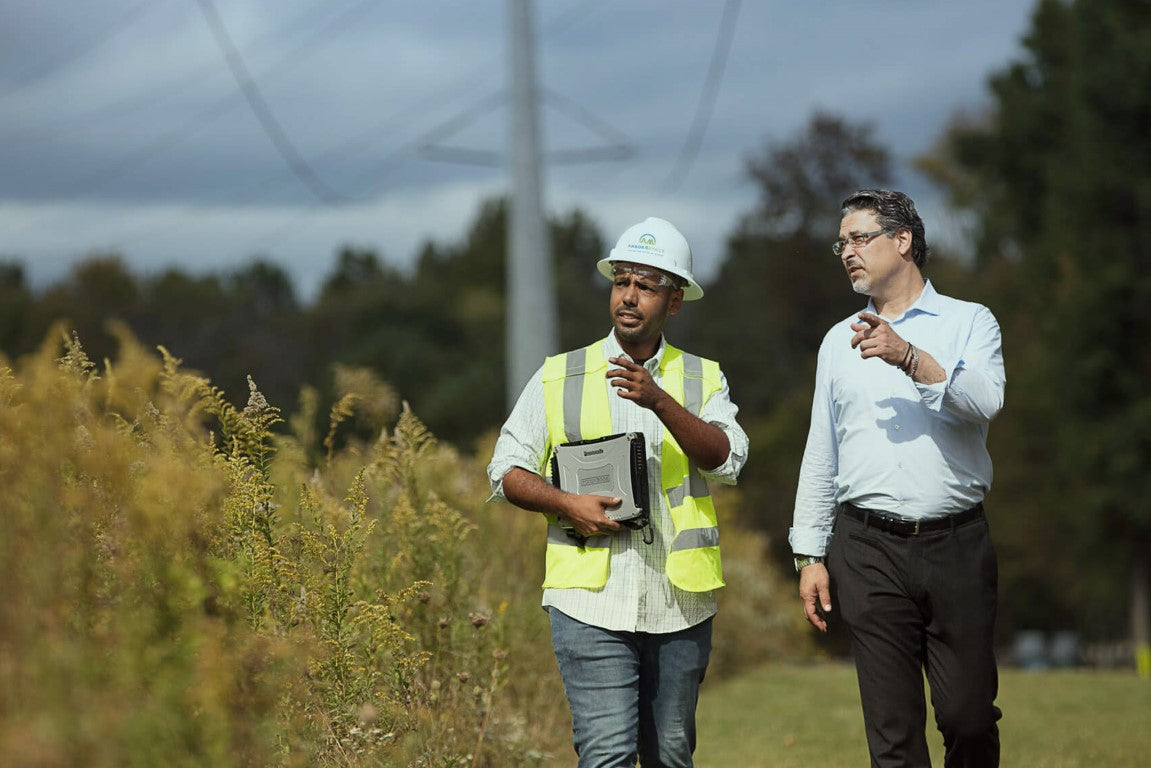
Condition Based Utility Vegetation Management Is Moving From Theory to Operational Reality
One of the strongest operational discussions emerging from the ROW14 Conference came from Robert Vanderhoof from Arbormetrics, focusing on the transition from traditional cycle based vegetation management toward condition based utility vegetation management.
The presentation challenged one of the longest standing assumptions within utility vegetation management programs — that vegetation risk can be effectively managed using broad time based maintenance cycles.
Drawing from reliability centred maintenance principles originally developed in the aviation and defence sectors, the presentation reinforced that most assets do not fail purely as a function of elapsed time. Instead, failure is generally linked to actual condition and the external forces acting upon the asset.
The same principle increasingly applies to vegetation systems.
Trees and vegetation do not develop risk uniformly across a corridor simply because a maintenance cycle expires. Growth rates, species composition, rainfall patterns, environmental stress, soil conditions and surrounding vegetation pressure all influence how risk develops across infrastructure networks.
This creates one of the major limitations of broad interval based vegetation management programs.

Many traditional utility vegetation management systems still rely heavily on fixed maintenance cycles, broad corridor clearing, elapsed time scheduling and periodic inspection programs.
The challenge is that these approaches often result in vegetation being managed because “the clock says so” rather than because measurable risk actually exists.
The presentation reinforced that condition based utility vegetation management is increasingly shifting toward measurable vegetation condition, risk based prioritisation, targeted intervention, predictive analytics, continuous monitoring and operational intelligence.
This is where technologies such as LiDAR, remote sensing, drone inspection and geospatial analytics become operationally significant.
Rather than relying solely on physical corridor patrols and cyclical maintenance schedules, utilities can increasingly quantify vegetation clearances, identify strike potential, monitor woody encroachment, assess vegetation growth trends, detect changing corridor conditions, prioritise intervention zones and integrate vegetation condition with built asset information.
One of the more relevant discussions throughout the session was the difference between historical reporting metrics and actual risk intelligence.
Traditional utility reporting often focuses on kilometres treated, trees removed, pruning volumes and maintenance expenditure.
While operationally important, these metrics often provide limited insight into actual vegetation risk across a network.
Condition based utility vegetation management instead focuses on understanding what vegetation presents risk, where the risk exists, how quickly conditions are changing and what intervention is actually required.
This fundamentally changes the way utilities approach planning, prioritisation and operational delivery.
The broader implication is significant.
Vegetation management is increasingly being viewed through the lens of reliability, wildfire mitigation, resilience, ESG performance, environmental stewardship and network risk reduction rather than simply cyclical maintenance expenditure.

The direction of travel across the utility vegetation management sector is becoming increasingly clear.
Condition based management supported by repeatable monitoring, measurable field intelligence and predictive analytics is rapidly moving from industry discussion into operational deployment.

Additional content
VIEW GWS' ADDITIONAL CONTENT TO LEARN MORE ABOUT THE WEED INDUSTRY
Selecting Herbicides Within an Integrated Vegetation Management Program
Effective herbicide selection begins long before a product is chosen. Within an Integrated Vegetation Management (IVM) program, herbicides are selected to support clearly defined management objecti...
Read more
Integrated Vegetation Management: Managing Outcomes, Not Treatments
A vegetation program is not defined by how many times a crew sprays or mows. It is defined by whether the asset is safe, functional and being managed to an agreed standard over time. Integrated Veg...
Read more
Supply disruption is a chance to review, plan and rotate.
When a major product becomes unavailable, it creates an important moment for the industry to pause, review and adapt. The recent supply disruption affecting a key industrial residual herbicide is a...
Read more