

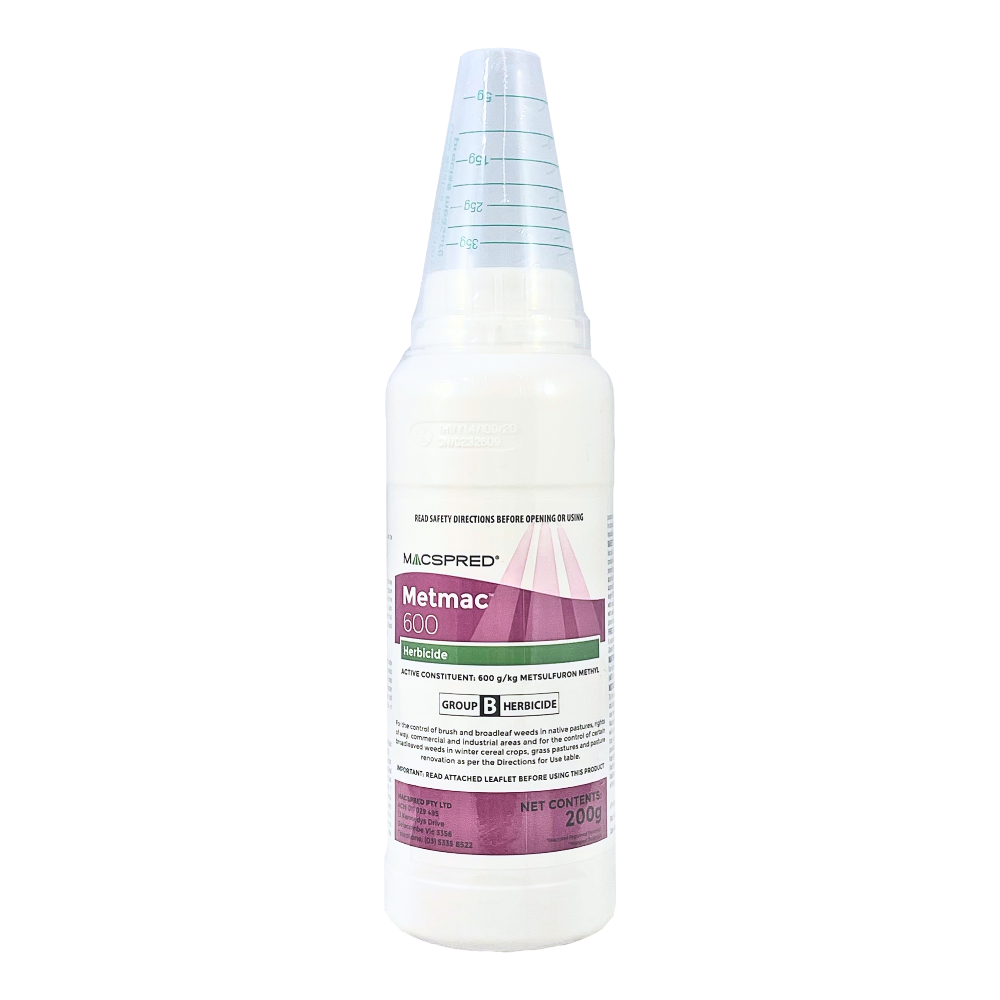
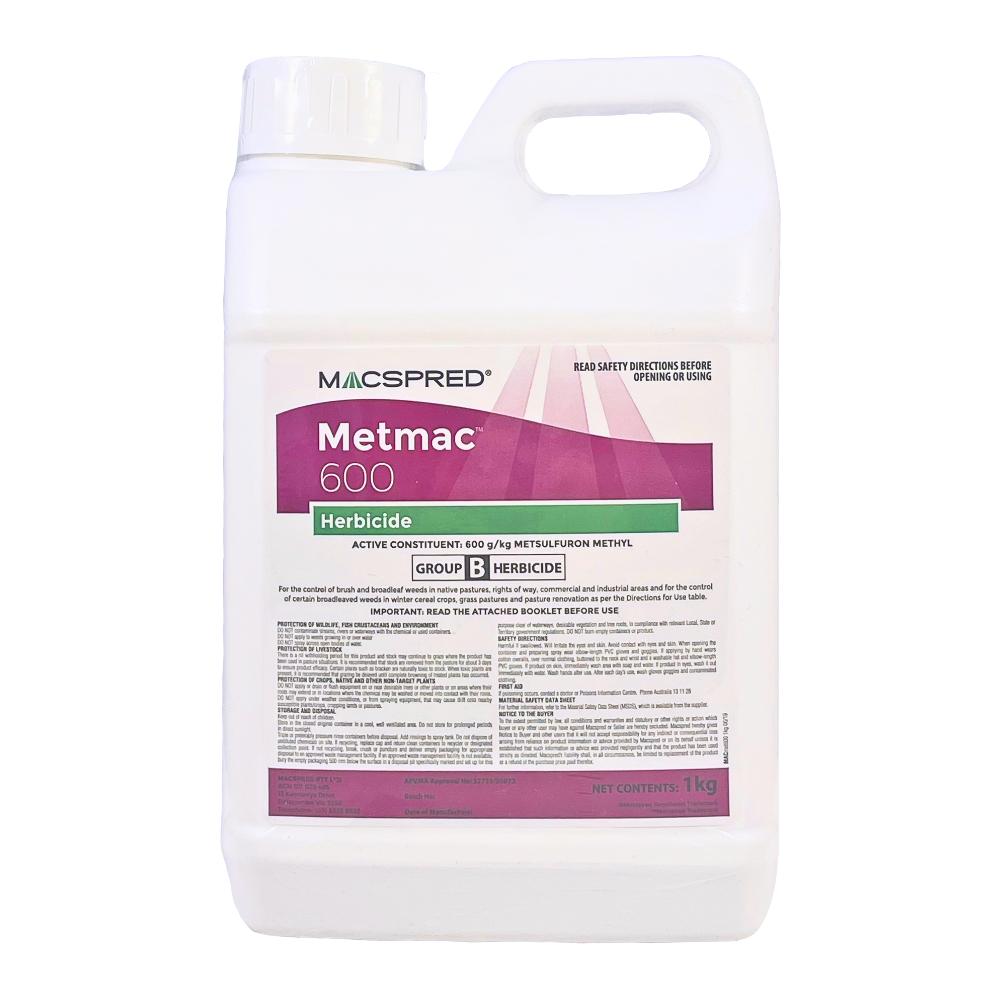
Macspred Metmac 600 WG. Metsulfuron methyl

Group 2 Herbicide
The Macspred Metmac 600WG Herbicide is a Group 2 Herbicide with 600 g/kg Metsulfuron Methyl as its active ingredient. It is used for controlling brush and broadleaf weeds in native pastures, rights of way, commercial and industrial areas, as well as in winter cereal crops, grass pastures, and pasture renovation.
Key Features:
-
Broad spectrum - Use Metmac alone or in a mixture controls a broad spectrum of different species of brush, broadleaf and bulbous weeds. Mixed infestations of hard to control woody weeds, including Lantana, Gorse, Bracken, Tree-of-Heaven, St John’s Wort and Blackberry, Metmac can be sprayed in one pass. Metmac also controls nuisance pasture weeds, including Doublegee, Erodium, Sorrel, Onion grass and Paterson’s Curse (refer to label).
-
Dry flowable product (1kg packs) - Metmac is easy to transport, store, handle, measure and mix.
-
Low application rate - Metmac is highly active, meaning less chemical is used per hectare.
-
Non hormonal, non volatile - Metmac can be safely applied near horticultural crops providing adequate measures are taken to avoid physical spray drift.
-
Unscheduled poison - Metmac has a relatively low toxicity and is classed as an unscheduled poison. When used as directed, it does not create any hazards to humans, fish or animals.
-
No withholding period for grazing - the half-life of residues on foliage treated with Metmac is less than one day; after 3 days, essentially no residues can be detected. Livestock DO NOT have to be removed from the paddock during spraying or immediately afterwards. Metmac does not accumulate in animals or the environment: it is readily metabolized in and eliminated from animals via natural processes.
-
Biodegradable - Metmac degrades rapidly in the environment. Metmac degrades readily in the soil and is not considered a persistent herbicide. Metmac exhibits a half life of about 4 weeks when it is used at normal rates.
-
Compatible with other selective and knockdown herbicides and insecticides - Metmac is compatible with the non-selective herbicide, glyphosate, and the pasture herbicides, 2,4-D amine, MCPA amine, clopyralid and dicamba for even broader spectrum control when cleaning pastures. Metmac is also compatible with the commonly used pasture insecticides chlorpyrifos and omethoate.
-
Safe to the environment - Metmac is very low in toxicity to mammals, birds, fish and insects.
Weeds Controlled:
Broadleaf and Herbaceous Weeds
-
African Turnip Weed (Sisymbrium thellungii)
-
Amsinckia / Yellow Burweed (Amsinckia spp.)
-
Ball Mustard (Neslia paniculata)
-
Boggabri Weed / Dwarf Amaranth (Amaranthus macrocarpus)
-
Calomba Daisy (Pentzia suffruticosa)
-
Cape Tulip (Homeria spp.)
-
Charlock (Sinapis arvensis)
-
Chickweed (Stellaria media)
-
Chicory (Cichorium intybus)
-
Clovers (Trifolium spp.)
-
Common Sowthistle (Sonchus oleraceus)
-
Cutleaf Mignonette (Reseda lutea)
-
Deadnettle (Lamium amplexicaule)
-
Denseflower Fumitory (Fumaria densiflora)
-
Dock (Broadleaf) (Rumex obtusifolius)
-
Faba Beans (Volunteer) (Vicia faba)
-
Field Peas (Volunteer) (Pisum sativum)
-
Hare’s Ear / Treacle Mustard (Conringia orientalis)
-
Hogweed / Wireweed (Polygonum aviculare)
-
Indian Hedge Mustard (Sisymbrium orientale)
-
Lincoln Weed (Diplotaxis tenuifolia)
-
Lupins (Volunteer) (Lupinus albus)
-
Mallee Catchfly (Silene apetala)
-
Medic (Volunteer Annual Medics) (Medicago spp.)
-
New Zealand Spinach (Tetragonia tetragonoides)
-
Parthenium Weed (Parthenium hysterophorus)
-
Paterson’s Curse / Salvation Jane (Echium plantagineum)
-
Prickly Lettuce (Lactuca serriola)
-
Red Pigweed (Portulaca oleracea)
-
Rough Poppy (Papaver hybridium)
-
Saltbush (Atriplex muelleri)
-
Shepherd’s Purse (Capsella bursa-pastoris)
-
Skeleton Weed (Suppression only) (Chondrilla juncea)
-
Slender Celery (Apium leptophyllum)
-
Smallflower Fumitory (Fumaria parviflora)
-
Sorrel (Rumex acetosella)
-
Soursob (Oxalis pes-caprae)
-
Spiny Emex / Doublegee / Threecornered Jack (Emex australis)
-
Stagger Weed (Stachys arvensis)
-
Storksbill / Wild Geranium (Erodium spp.)
-
Turnip Weed (Rapistrum rugosum)
-
Volunteer Sunflower (Helianthus annuus)
-
Wild / Crow Garlic (Allium vineale)
-
Wild Turnip (Brassica tournefortii)
Woody and Tough Weeds
-
Alligator Weed (Alternanthera philoxeroides)
-
Apple Box (Angophora floribunda)
-
Australian Blackthorn (Bursaria spinosa)
-
Bellyache Bush (Jatropha gossypifolia)
-
Blackberry (Rubus spp.)
-
Bitou Bush / Boneseed (Chrysanthemoides monilifera)
-
Bridal Creeper (Asparagus asparagoides)
-
Common Bracken (Pteridium esculentum)
-
Crofton Weed (Ageratina adenophora)
-
Darling Pea (Swainsona spp.)
-
Fennel (Foeniculum vulgare)
-
Golden Dodder (Cuscuta australis)
-
Great Mullein (Verbascum thapsus)
-
Harrisia Cactus (Eriocereus spp.)
-
Hawthorn (Crataegus laevigata)
-
Inkweed (Phytolacca octandra)
-
Japanese Sunflower (Tithonia diversifolia)
-
Kangaroo Thorn (Acacia paradoxa)
-
Lantana (Lantana camara)
-
Messmate Stringybark (Eucalyptus obliqua)
-
Mistflower / Creeping Crofton (Eupatorium riparium)
-
Narrowleaf Peppermint (Eucalyptus radiata)
-
Noogoora Burr (Xanthium pungens)
-
Privet (Ligustrum spp.)
-
Ragwort (Senecio jacobaea)
-
Rubber Vine (Cryptostegia grandiflora)
-
Smartweed (Polygonum spp.)
-
Sweet Briar (Rosa rubiginosa)
-
Tree of Heaven (Ailanthus altissima)
-
Wait-a-While (Caesalpinia decapelata)
-
Yellow Box (Eucalyptus melliodora)
SHORT DESCRIPTION
The Macspred Metmac 600WG Herbicide is a Group 2 Herbicide with 600 g/kg Metsulfuron Methyl as its active ingredient. It is used for controlling brush and broadleaf weeds in native pastures, rights of way, commercial and industrial areas, as well as in winter cereal crops, grass pastures, and pasture renovation.
ACTIVE INGREDIENTS
600g/kg Metsulfuron methyl
APPLICATION INFORMATION
REFER TO THE LABEL FOR THE FULL APPLICATION INFORMATION ==========
GENERAL APPLICATION RATES
Boom Spray - Rate: 5-10g/ha
Handgun - Rate: 10g/100L water
Knapsack - Rate 1g/10L water
Aerial Application - Rate: 6-100L water/ha
Gas gun - Rate: 10g/10L water
1. Pastures, Rights of Way, Commercial and Industrial Areas
Target Weeds:
Blackberry, Bitou Bush, Boneseed, Capeweed, Lantana, Mistflower, Privet, Ragwort, St John’s Wort, Sweet Briar, Tree of Heaven, Wild Radish, Wild Turnip, and other broadleaf and woody weeds.
States:
QLD, NSW, VIC, SA, TAS, WA (as specified per weed)
Application Rate:
Boom Spray: 5 - 10 g/ha
Hand Gun: 10 g/100 L water
Knapsack: 1 g/10 L water
Aerial (Helicopter Only): 60 - 100 L water/ha
Gas Gun: 10 g per 10 L water
Critical Comments:
Ensure thorough coverage of foliage and stems for effective weed control.
Use high volume spraying for dense infestations.
Add a surfactant at recommended rates for improved efficacy.
Apply during active growth periods, preferably spring to autumn.
Avoid spray drift onto crops, waterways, or non-target plants.
2. Native Pastures (Selective Weed Control)
Target Weeds:
Capeweed, Paterson’s Curse, Wild Turnip, Sorrel, Storksbill, Ragwort.
States:
QLD, NSW, VIC, SA, TAS, WA
Application Rate:
Boom Spray: 5 - 7.5 g/ha
Hand Gun: 10 g/100 L water
Knapsack: 1 g/10 L water
Critical Comments:
Best applied when weeds are actively growing and before flowering.
Do not use on newly sown pastures or pasture seed crops.
Always add a non-ionic surfactant.
Avoid grazing pastures for 3 days post-application for optimal results.
3. Forestry and Plantation Use (Pre- and Post-Planting)
Target Weeds:
Annual broadleaf weeds, Blackberry, Gorse, Privet, Lantana, Mistflower, and Tree of Heaven.
States:
QLD, NSW, VIC, SA, TAS, WA
Application Rate:
Boom Spray: 5 - 10 g/ha
Hand Gun: 10 g/100 L water
Knapsack: 1 g/10 L water
Aerial Application: 60 - 100 L water/ha
Critical Comments:
Apply before planting or after seedlings establish.
Use higher rates for woody species (e.g., Gorse, Privet).
Apply in spring to autumn for best control of brush weeds.
Avoid soil disturbance for at least 3 months post-treatment.
4. Winter Cereal Crops (Wheat, Barley, Triticale, Rye)
Target Weeds:
Wild Turnip, Wild Radish, Capeweed, Deadnettle, Wireweed, Shepherd’s Purse.
States:
QLD, NSW, VIC, SA, TAS, WA
Application Rate:
Boom Spray: 5 - 7.5 g/ha
Critical Comments:
Apply before weeds reach 6-leaf stage.
Use higher rates for heavily infested areas.
Avoid use on sandy or light soils with high leaching potential.
Do not use in waterlogged soils.
5. Pasture Renovation
Target Weeds:
Sorrel, Skeleton Weed, Storksbill, Capeweed, Paterson’s Curse.
States:
QLD, NSW, VIC, SA, TAS, WA
Application Rate:
Boom Spray: 5 - 10 g/ha
Hand Gun: 10 g/100 L water
Critical Comments:
Apply before seeding new pasture species.
Allow 6 - 8 weeks after application before replanting.
Suitable for selective broadleaf control in grass pastures.
6. Brush and Woody Weed Control (High Volume Spray)
Target Weeds:
Blackberry, Gorse, Lantana, Mistflower, Privet, Sweet Briar, Tree of Heaven.
States:
QLD, NSW, VIC, SA, TAS, WA
Application Rate:
Hand Gun: 10 g/100 L water
Knapsack: 1 g/10 L water
Gas Gun: 10 g per 10 L water
Critical Comments:
Best applied in spring to autumn during active growth.
Ensure complete coverage of foliage.
Do not apply to stressed or dormant plants.
Use higher volumes for dense brush infestations.
7. Industrial and Rights of Way
Target Weeds:
Alligator Weed, Blackberry, Bracken, Lantana, Privet, Tree of Heaven.
States:
QLD, NSW, VIC, SA, TAS, WA
Application Rate:
Boom Spray: 5 - 10 g/ha
Hand Gun: 10 g/100 L water
Critical Comments:
Suitable for railways, roadsides, utilities, public service areas.
Avoid spraying near water sources.
Long residual activity, so do not disturb treated areas.
General Application Guidelines
Mixing Instructions:
Fill spray tank halfway with clean water before adding Metmac 600WG.
Add surfactant for improved uptake.
Maintain constant agitation in the spray tank.
Weather Conditions:
Avoid spraying in strong winds or hot conditions.
Do not apply if rainfall is expected within 2-6 hours.
Sprayer Cleanup:
Wash all spray equipment thoroughly after use.
Use household bleach (4% chlorine) solution to remove residues.
WEEDS CONTROLLED
Weeds Controlled
African Turnip Weed (Sisymbrium thellungii)
Alligator Weed (Alternanthera philoxeroides)
Amsinckia / Yellow Burweed (Amsinckia spp.)
Apple Box (Angophora floribunda)
Australian Blackthorn (Bursaria spinosa)
Ball Mustard (Neslia paniculata)
Bellyache Bush (Jatropha gossypiifolia)
Blackberry (Rubus spp.)
Bitou Bush / Boneseed (Chrysanthemoides monilifera)
Boggabri Weed / Dwarf Amaranth (Amaranthus macrocarpus)
Bridal Creeper (Asparagus asparagoides)
Calomba Daisy (Pentzia suffruticosa)
Cape Tulip (Homeria spp.)
Capeweed (Arctotheca calendula)
Charlock (Sinapis arvensis)
Chickweed (Stellaria media)
Chicory (Cichorium intybus)
Clovers (Trifolium spp.)
Common Bracken (Pteridium esculentum)
Common Sowthistle (Sonchus oleraceus)
Crofton Weed (Ageratina adenophora)
Cutleaf Mignonette (Reseda lutea)
Darling Pea (Swainsona spp.)
Deadnettle (Lamium amplexicaule)
Denseflower Fumitory (Fumaria densiflora)
Dock (Broadleaf) (Rumex obtusifolius)
Faba Beans (Volunteer) (Vicia faba)
Fennel (Foeniculum vulgare)
Field Peas (Volunteer) (Pisum sativum)
Golden Dodder (Cuscuta australis)
Great Mullein (Verbascum thapsus)
Harrisia Cactus (Eriocereus spp.)
Hare’s Ear / Treacle Mustard (Conringia orientalis)
Hawthorn (Crataegus laevigata)
Hogweed / Wireweed (Polygonum aviculare)
Indian Hedge Mustard (Sisymbrium orientale)
Inkweed (Phytolacca octandra)
Japanese Sunflower (Tithonia diversifolia)
Kangaroo Thorn (Acacia paradoxa)
Lantana (Lantana camara)
Lincoln Weed (Diplotaxis tenuifolia)
Lupins (Volunteer) (Lupinus albus)
Mallee Catchfly (Silene apetala)
Medic (Volunteer Annual Medics) (Medicago spp.)
Messmate Stringybark (Eucalyptus obliqua)
Mistflower / Creeping Crofton (Eupatorium riparium)
Narrowleaf Peppermint (Eucalyptus radiata)
New Zealand Spinach (Tetragonia tetragonoides)
Noogoora Burr (Xanthium pungens)
Parthenium Weed (Parthenium hysterophorus)
Paterson’s Curse / Salvation Jane (Echium plantagineum)
Prickly Lettuce (Lactuca serriola)
Privet (Ligustrum spp.)
Ragwort (Senecio jacobaea)
Red Pigweed (Portulaca oleracea)
Rough Poppy (Papaver hybridium)
Rubber Vine (Cryptostegia grandiflora)
Saltbush (Atriplex muelleri)
Shepherd’s Purse (Capsella bursa-pastoris)
Skeleton Weed (Suppression only) (Chondrilla juncea)
Slender Celery (Apium leptophyllum)
Smallflower Fumitory (Fumaria parviflora)
Sorrel (Rumex acetosella)
Soursob (Oxalis pes-caprae)
Spiny Emex / Doublegee / Threecornered Jack (Emex australis)
Stagger Weed (Stachys arvensis)
Storksbill / Wild Geranium (Erodium spp.)
Sweet Briar (Rosa rubiginosa)
Tree of Heaven (Ailanthus altissima)
Turnip Weed (Rapistrum rugosum)
Volunteer Sunflower (Helianthus annuus)
Wait-a-While (Mysore Thorn) (Caesalpinia decapetala)
Wild / Crow Garlic (Allium vineale)
Wild Radish (Raphanus raphanistrum)
Wild Turnip (Brassica tournefortii)
Yellow Box (Eucalyptus melliodora)
PRODUCT LABEL SUMMARY
PLEASE REFER TO THE LABLE FOR FULL DETAILS ==========
1. Product Information
Product Name: Macspred Metmac 600 Herbicide
Active Constituent: 600 g/kg Metsulfuron Methyl
Group Classification: Group B Herbicide
Pack Sizes: Available in 200 g and 1 kg
Manufacturer: Macspred Pty Ltd, Delacombe VIC, Australia
2. Directions for Use
General Restraints:
Do not apply if rainfall is expected within 2-6 hours (varies by situation).
Do not apply to waterlogged or stressed plants.
Do not use on newly sown pastures or pasture seed crops.
Always add a surfactant/wetting agent.
Application Methods:
Boom Spray
Hand Gun
Knapsack
Aerial (Helicopter)
Gas Gun
Situations Covered:
Native pastures
Rights of way
Commercial and industrial areas
Forestry
Public service areas
Winter cereal crops
Established pastures
3. Weeds Controlled
Macspred Metmac 600WG controls a wide range of broadleaf weeds, woody weeds, and brush weeds, including:
Broadleaf Weeds:
Capeweed, Charlock, Chickweed, Clovers, Deadnettle, Fennel, Paterson’s Curse, Prickly Lettuce, Skeleton Weed, Sorrel, Turnip Weed, Wild Radish, Wild Turnip, etc.
Woody and Brush Weeds:
Blackberry, Bitou Bush, Bridal Creeper, Gorse, Lantana, Privet, Ragwort, Sweet Briar, Tree of Heaven, etc.
(For a full list of weeds, refer to the Detailed Weeds Controlled Section in the label.)
4. Withholding Periods
Cereals: Not required when used as directed.
Pastures and other uses: Not required when used as directed.
Tank mixes with certain herbicides (e.g., 2,4-D, Bromoxynil): A 3-14 day grazing restriction may apply.
5. Protection Guidelines
Protection of Wildlife, Fish, Crustaceans, and Environment
Do not apply to weeds growing in or over water.
Do not spray across open bodies of water.
Avoid contamination of streams, rivers, or waterways.
Protection of Livestock
Nil withholding period for pasture grazing.
Recommended to remove stock for 3 days to ensure maximum efficacy.
Protection of Crops, Native Plants, and Non-Target Areas
Avoid spray drift to nearby sensitive plants and crops.
Do not apply in weather conditions that may cause chemical drift.
6. Storage and Disposal
Store in the original container in a cool, well-ventilated area.
Do not store in direct sunlight or prolonged periods.
Triple rinse containers before disposal.
Dispose of empty packaging responsibly in compliance with local regulations.
7. Safety Directions
Harmful if swallowed.
Irritant to skin and eyes.
Protective Equipment (PPE):
Elbow-length PVC gloves
Goggles
Cotton overalls buttoned to the neck and wrist
First Aid:
If swallowed, contact a doctor or Poisons Information Centre (Australia: 13 11 26).
If in eyes, rinse immediately with plenty of water.
8. Resistance Management
Macspred Metmac 600WG is a Group B Herbicide (ALS inhibitor).
Weed Resistance Warning:
Repeated use of Group B herbicides may lead to the development of resistant weeds.
Implement integrated weed management strategies to delay resistance.
9. Spray Preparation & Application Instructions
Mixing:
Always add surfactants/wetting agents.
Use clean water when preparing the spray mix.
Keep the solution agitated to prevent settling.
Spray Equipment:
Boom Sprayer: Use 150-200 L/ha of spray volume.
Hand Gun: Use 10 g/100 L water.
Aerial Application (Helicopter Only): Use 60-100 L/ha.
Gas Gun: Ensure thorough coverage.
Tank Mix Compatibility:
Compatible with glyphosate and broadleaf herbicides such as MCPA, Clopyralid, 2,4-D, Dicamba.
Check compatibility before mixing with liquid fertilizers.
10. Crop Rotation Recommendations
Minimum Recropping Intervals:
Wheat, Barley, Rye, Triticale: 10 days
Canola, Chickpeas, Faba Beans: 6 weeks
Lupins, Medics, Lucerne: 9 months
Maize, Sorghum, Sunflowers: 14 months
Crops Sensitive to Metsulfuron-Methyl:
Barley, Canola, Lupins, Medics, Sub Clover, Sorghum, Sunflower.
11. Sprayer Cleanup
Thoroughly clean sprayers after use to prevent cross-contamination.
Use household bleach (4% chlorine) to remove residues.
Flush nozzles, screens, and tanks properly.
LABEL, SDS & TECH SHEET
SHIPPING & RETURNS
Greenway Weed Solutions has a distribution centre in QLD only, All orders, Australia-wide will be shipped from this location.
Shipping is free for all online orders Australia-wide. Bulk purchases may incur additional shipping costs - P.O.A for large quantity items.
Pickups are available from the QLD warehouse. Updates to product availability in other Australian warehouses are upcoming.
Choose options
explore our latest Blogs
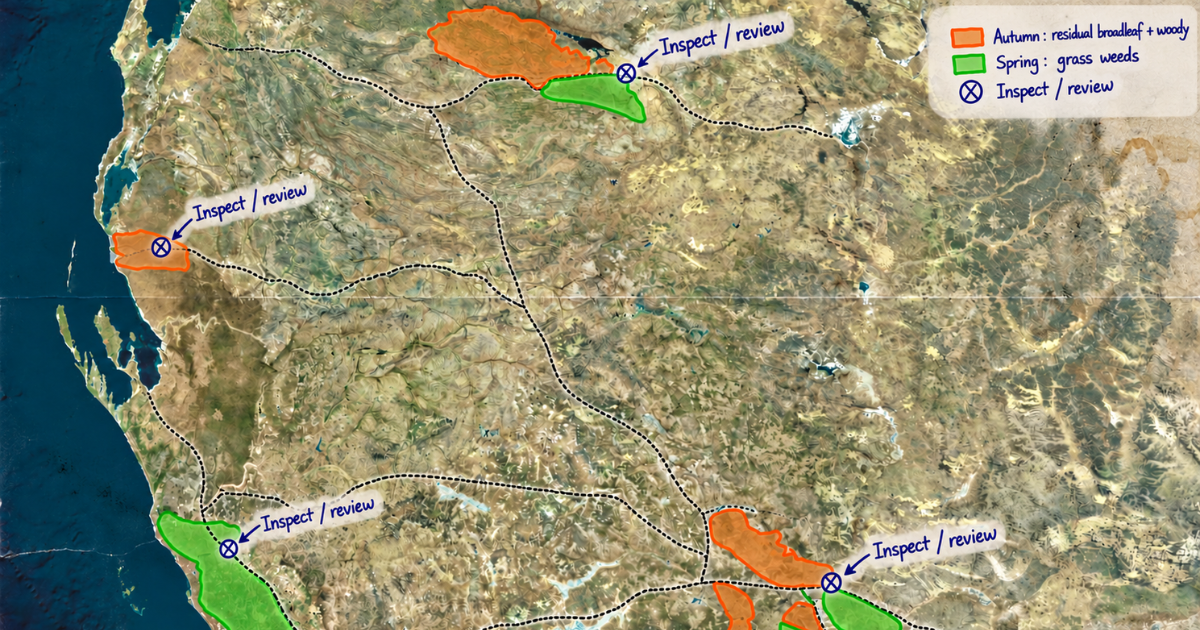
Developing an Annual Vegetation Management Plan for Infrastructure Assets
An Annual Vegetation Management Plan provides the framework for managing infrastructure assets safely, efficiently and sustainably throughout the year. Rather than responding to issues as they aris...
Read more
Selecting Herbicides Within an Integrated Vegetation Management Program
Effective herbicide selection begins long before a product is chosen. Within an Integrated Vegetation Management (IVM) program, herbicides are selected to support clearly defined management objecti...
Read more
Integrated Vegetation Management: Managing Outcomes, Not Treatments
A vegetation program is not defined by how many times a crew sprays or mows. It is defined by whether the asset is safe, functional and being managed to an agreed standard over time. Integrated Veg...
Read more