

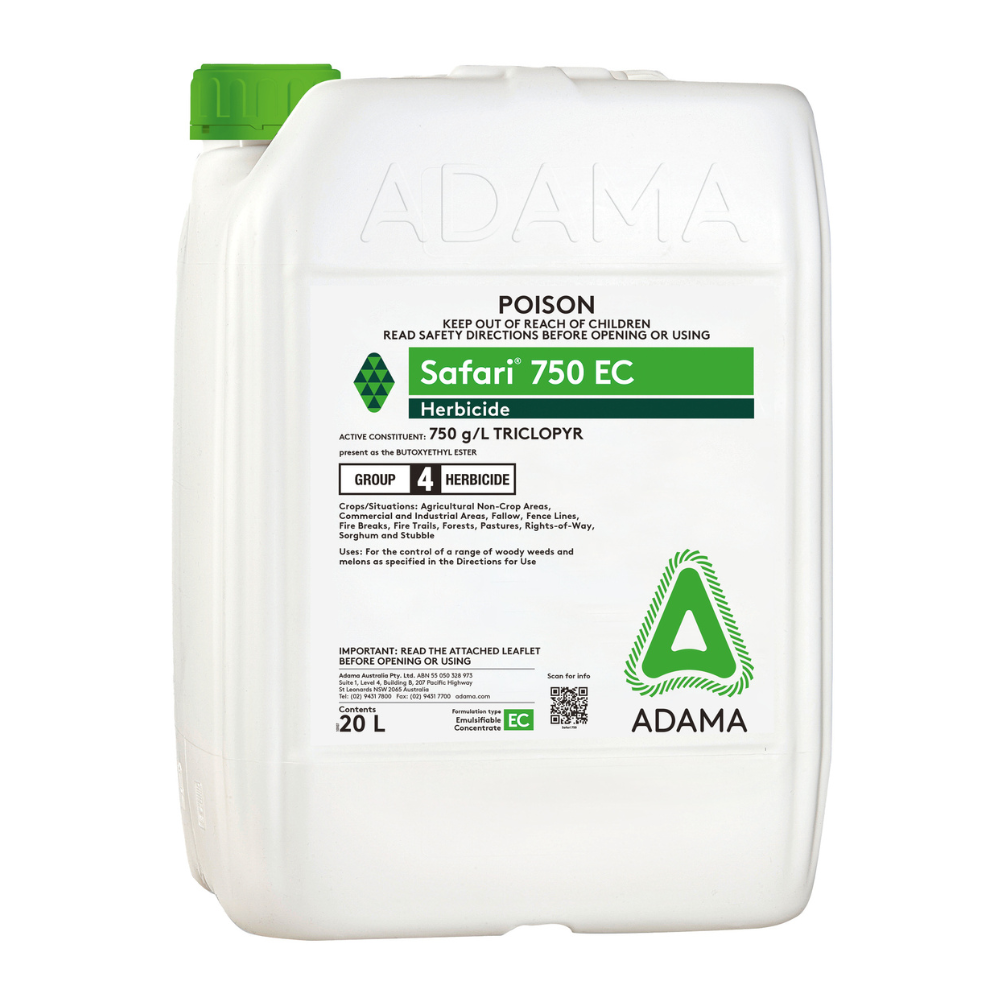
Adama Safari 750 EC 20L Triclopyr

Group 4 Herbicide
Safari 750 EC Herbicide is used to control a variety of woody weeds, broadleaf weeds, and melons in agricultural non-crop areas, industrial areas, pastures, forests, fallow, and sorghum crops.
Key Features:
-
750 g/L Triclopyr (EC formulation) for effective woody weed and melon control.
-
Group 4 herbicide targeting plant cell growth disruptors.
-
Registered for non-crop areas, pastures, forests, rights-of-way, and sorghum crops.
-
Controls woody weeds (blackberry, eucalyptus, gorse) and melons (camel, prickly paddy).
-
Multiple application methods – high volume, aerial, CDA, and air blast spraying.
-
Rainfast in 1 hour (6 hours with Wipe-Out).
-
Broad-spectrum control – effective on young regrowth and mature weeds.
-
Compatible with 2,4-D, Wipe-Out, Flagship, and other herbicides.
-
Minimum re-cropping period of 7-14 days for key crops.
Maximising Performance:
-
Apply to actively growing weeds – avoid stressed or dormant plants.
-
Ensure full coverage – use correct spray volume for thorough contact.
-
Choose the right method – high volume for dense weeds, aerial for broad coverage.
-
Time applications correctly – best results late spring to early autumn.
-
Avoid rain after spraying – at least 1-6 hours rain-free needed.
-
Follow proper tank-mixing – add Safari 750 EC before herbicides.
-
Use surfactants for better penetration on tough weeds.
-
Apply higher rates for larger weeds to ensure complete kill.
-
Minimise drift – avoid spraying in wind >10 km/h.
-
Monitor regrowth – follow-up treatments may be needed.
-
Clean equipment to prevent contamination of sensitive crops.
-
Follow withholding periods – 7-14 days before planting new crops.
-
Mix with other herbicides for broader weed control in fallow and cropping.
Weeds Controlled:
Woody Weeds
-
African Boxthorn (Lycium ferocissimum)
-
Blackberry (Rubus fruticosus)
-
Brigalow (Acacia harpophylla)
-
Broom, English (Cytisus scoparius)
-
Camphor Laurel (Cinnamomum camphora)
-
Common Prickly Pear (Opuntia stricta)
-
Eucalyptus (Eucalyptus spp.)
-
Gorse (Ulex europaeus)
-
Green Cestrum (Cestrum parqui)
-
Groundsel Bush (Baccharis halimifolia)
-
Horehound (Marrubium vulgare)
-
Silver Wattle (Acacia dealbata)
-
Black Wattle (Acacia mearnsii)
-
Tiger Pear (Opuntia aurantiaca)
Broadleaf Weeds
-
Capeweed (Arctotheca calendula)
-
Fennel (Foeniculum vulgare)
-
Saffron Thistle (Carthamus lanatus)
-
St John’s Wort (Hypericum perforatum)
-
English Ivy (Hedera helix)
Melons
-
Camel Melon (Citrullus lanatus)
-
Prickly Paddy Melon (Cucumis myriocarpus)
SHORT DESCRIPTION
Broadleaf and woody weed control in fallow and non-crop situations.
Crops/Situations: Agricultural Non-Crop Areas, Commercial and Industrial Areas, Fallow, Fence Lines, Fire Breaks, Fire Trails, Forests, Pastures, Rights-of-Way, Sorghum and Stubble
Uses: For the control of a range of woody weeds and melons as specified in the Directions for Use.
ACTIVE INGREDIENTS
750 g/L Triclopyr
APPLICATION INFORMATION
Application Information and Rates
Application Methods
Safari 750 EC Herbicide is applied using high volume spraying, air blast spraying, aerial application, and controlled droplet application (CDA). It is used in agricultural non-crop areas, commercial and industrial areas, forests, pastures, rights-of-way, fallow, and sorghum crops.
Restraints
Do not apply to weeds under stress from drought, extreme cold, waterlogging, poor nutrition, disease, or previous herbicide treatment.
Do not spray if rain is likely within one hour, or within six hours when mixed with Wipe-Out.
Do not burn off, cut, or clear blackberry or woody weeds for six months after spraying.
Do not apply using handheld application methods or equipment carried on the back.
Woody Weed Control
Application Method: High Volume Spraying
Ensure thorough coverage of foliage and stems to the point of run-off.
African Boxthorn - Less than 2 m tall - 136 mL per 100 L water - Tasmania only
Blackberry - Late Spring to Autumn - 136 mL per 100 L water - All States
English Ivy - Active Growth (Spring-Summer) - 800 mL plus 800 mL Wipe-Out 450 per 100 L water - Victoria only
Eucalyptus - Seedlings 1-2 m tall - 320 to 448 mL per 100 L water - Various states
Green Cestrum - Actively Growing - 136 mL per 100 L water - Queensland, New South Wales, Victoria
Prickly Pear - Active Growth - 2.4 L per 100 L water - All States
Tiger Pear - Active Growth - 2.4 L per 100 L water - All States
Application Method: Air Blast Spraying (Mist Blower)
Do not spray within 1 km of susceptible crops.
Eucalyptus - All States - 256 mL per 10 L water
Blackberry - All States - 256 mL per 10 L water
Brigalow - Queensland, New South Wales - 256 mL per 10 L water
Application Method: Aerial Application
Used for blackberry and other woody weeds. Avoid overspray or drift onto waterways.
Blackberry - Late Spring to Autumn - 3.84 L per hectare - All States
Application Method: Controlled Droplet Application (CDA)
Used for woody weeds and applied with low-volume misting equipment.
Blackberry - Late Spring to Autumn - 136 mL per 1 L water - All States
Cropping and Fallow Situations
Application Method: High Volume Spraying
Used for fallow, stubble, and firebreaks.
Application Method: Boom Spraying
Used in a minimum spray volume of 50 L per hectare with flat fan nozzles at 200-300 kPa.
Application Method: Aerial Application
Used when ground application is not possible due to wet conditions. Minimum spray volume of 35 L per hectare.
Weeds Controlled in Cropping and Fallow
Camel Melon - Up to 20 cm diameter - 96 mL per hectare - Queensland, New South Wales, Victoria, South Australia, Western Australia
Prickly Paddy Melon - Up to 20 cm diameter - 64 mL per hectare - Queensland, New South Wales
Sorghum Weed Control
Apply between the 4 to 6 leaf stage when secondary roots have developed.
Prickly Paddy Melon - Up to 20 cm diameter - 64 mL per hectare - Queensland, New South Wales
Camel Melon - Up to 20 cm diameter - 96 mL per hectare - Queensland, New South Wales, Victoria, South Australia, Western Australia
Withholding Periods
Pasture: Not required when used as directed.
Sorghum: Not required when used as directed.
WEEDS CONTROLLED
Weeds Controlled
Safari 750 EC Herbicide is used to control a variety of woody weeds, broadleaf weeds, and melons in agricultural non-crop areas, industrial areas, pastures, forests, fallow, and sorghum crops. Below is a list of the weeds controlled, including their scientific names.
Woody Weeds
African Boxthorn (Lycium ferocissimum)
Blackberry (Rubus fruticosus)
Brigalow (Acacia harpophylla)
Broom, English (Cytisus scoparius)
Camphor Laurel (Cinnamomum camphora)
Common Prickly Pear (Opuntia stricta)
Eucalyptus (Eucalyptus spp.)
Gorse (Ulex europaeus)
Green Cestrum (Cestrum parqui)
Groundsel Bush (Baccharis halimifolia)
Horehound (Marrubium vulgare)
Silver Wattle (Acacia dealbata)
Black Wattle (Acacia mearnsii)
Tiger Pear (Opuntia aurantiaca)
Broadleaf Weeds
Capeweed (Arctotheca calendula)
Fennel (Foeniculum vulgare)
Saffron Thistle (Carthamus lanatus)
St John’s Wort (Hypericum perforatum)
English Ivy (Hedera helix)
Melons
Camel Melon (Citrullus lanatus)
Prickly Paddy Melon (Cucumis myriocarpus)
PRODUCT LABEL SUMMARY
Herbicide Label Summary
Product Name: Safari 750 EC Herbicide
APVMA Approval Number: 83125/111052
Contents: Available in 1 L - 1000 L containers
Active Constituent: 750 g/L Triclopyr (present as butoxyethyl ester)
Formulation Type: Emulsifiable Concentrate (EC)
Herbicide Group: Group 4 Herbicide
Primary Use: Control of woody weeds and melons in agricultural, industrial, and non-crop areas
POISON WARNING
Keep out of reach of children
Read safety directions before opening or using
Approved Crops & Situations
Safari 750 EC is registered for use in agricultural non-crop areas, commercial and industrial areas, fallow, fence lines, fire breaks, forests, pastures, rights-of-way, and sorghum crops
Directions for Use
Restraints
Do not apply to stressed weeds (drought, extreme cold, waterlogging, poor nutrition, disease)
Do not spray if rain is likely within 1 hour (extends to 6 hours if mixed with Wipe-Out)
Do not burn off, cut, or clear blackberry or woody weeds within 6 months of spraying
Do not apply using handheld equipment or backpacks
Woody Weed Control
Used in agricultural non-crop areas, forests, pastures, and rights-of-way
Application methods include high volume spraying, air blast spraying, aerial application, and controlled droplet application
Example Weeds Controlled
African Boxthorn - Less than 2 m tall - 136 mL/100 L water - TAS only
Blackberry - Late Spring to Autumn - 136 mL/100 L water - All States
English Ivy - Active Growth (Spring-Summer) - 800 mL + 800 mL Wipe-Out 450 - VIC only
Eucalyptus - Seedlings 1-2 m tall - 320-448 mL/100 L water - Various
Green Cestrum - Actively Growing - 136 mL/100 L water - QLD, NSW, VIC
Prickly Pear - Active Growth - 2.4 L/100 L water - All States
Tiger Pear - Active Growth - 2.4 L/100 L water - All States
Cropping & Fallow Situations
Used for firebreaks, stubble management, and fallow weed control
Application methods include high volume spraying, boom spraying, and aerial application
Example Weeds Controlled in Cropping/Fallow
Camel Melon - Up to 20 cm diameter - 96 mL/ha - QLD, NSW, VIC, SA, WA
Prickly Paddy Melon - Up to 20 cm diameter - 64 mL/ha - QLD, NSW
Withholding Periods (WHP)
Pasture: Not required when used as directed
Sorghum: Not required when used as directed
General Instructions
Mixing
Add half the required water to the spray tank first, then add Safari 750 EC while agitating continuously
Surfactants or wetters are recommended for best results
Follow the correct mixing order to avoid compatibility issues
Application Methods
Aerial Application requires 100-200 L/ha spray volume with a minimum droplet size of 250-350 microns
Boom Spraying requires 50 L/ha minimum with flat fan nozzles
Controlled Droplet Application (CDA) requires a flow rate of 2 mL/sec and proper spray coverage
Compatibility
Safari 750 EC is compatible with 2,4-D LV Ester 680, 2,4-D Amine 625, Zulu, Flagship, Wetspray, Wipe-Out, Victory, and Strike-Out
For sorghum, it is compatible with Flagship and flowable atrazine herbicides
Do not mix with Uptake Spraying Oil or DC Trate Crop Oil due to crop damage risks
Minimum Re-Cropping Periods
Wheat, Barley, Sorghum, Maize - 7 days
Chickpeas, Soybeans, Sunflowers - 7 days
Cotton - 14 days
Cleaning Spray Equipment
Triple rinse the spray unit after use
Use an alkali detergent (e.g., OMO, DRIVE, SURF) for decontamination
Dispose of rinse water away from desirable plants and water sources
Resistant Weeds Warning
Safari 750 EC is a Group 4 Herbicide (Pyridine Class)
Some naturally resistant weed biotypes may exist
Repeated use of Group 4 herbicides can lead to herbicide resistance
Safety & Protection Warnings
Re-Entry Period
Do not enter treated areas until the spray has dried unless wearing protective clothing
Protection of Crops, Native & Non-Target Plants
Sensitive crops include peas, lupins, lucerne, navy beans, soybeans, cotton, fruit, ornamentals, tobacco, vegetables, and vines
Do not allow spray drift onto sensitive plants, pastures, or cropping land
Protection of Livestock
Poisonous plants may become more palatable after spraying
Keep livestock away until plants have fully died down
Protection of Wildlife, Fish, & Environment
Highly toxic to fish and aquatic organisms
Do not contaminate waterways with spray drift or used containers
Storage & Disposal
Store in original container in a cool, well-ventilated area
Do not store in direct sunlight for extended periods
Triple rinse containers before disposal
Recycle if possible (drumMUSTER program)
If not recycling, bury the container 500 mm underground in a disposal pit away from waterways
Safety Directions
Harmful if swallowed
May irritate the nose, throat, eyes, and skin
Repeated exposure may cause allergic reactions
Wear protective clothing, gloves, and face shield when handling
First Aid Instructions
If poisoning occurs, contact a doctor or Poisons Information Centre (Australia: 13 11 26)
If in eyes, rinse immediately with water for at least 15 minutes and seek medical attention
Conditions of Sale
No warranty is given regarding suitability, fitness, or efficiency
Adama Australia accepts no liability for consequences resulting from misuse
LABEL, SDS & TECH SHEET
SHIPPING & RETURNS
Greenway Weed Solutions has a distribution centre in QLD only. All orders, Australia-wide will be shipped from this location.
Shipping is free on all online orders. Bulk purchase shipping rates are determined by total order weight and delivery location.
Pickups are available from the QLD warehouse. Updates to product availability in other Australian warehouses are upcoming.
Choose options
explore our latest Blogs
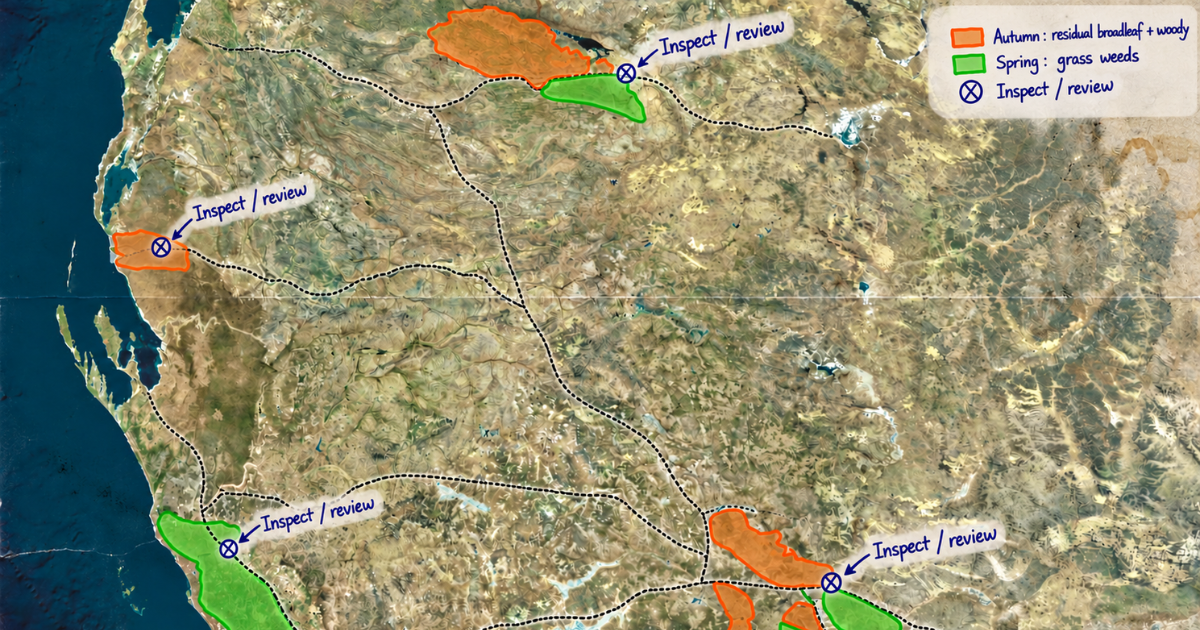
Developing an Annual Vegetation Management Plan for Infrastructure Assets
An Annual Vegetation Management Plan provides the framework for managing infrastructure assets safely, efficiently and sustainably throughout the year. Rather than responding to issues as they aris...
Read more
Selecting Herbicides Within an Integrated Vegetation Management Program
Effective herbicide selection begins long before a product is chosen. Within an Integrated Vegetation Management (IVM) program, herbicides are selected to support clearly defined management objecti...
Read more
Integrated Vegetation Management: Managing Outcomes, Not Treatments
A vegetation program is not defined by how many times a crew sprays or mows. It is defined by whether the asset is safe, functional and being managed to an agreed standard over time. Integrated Veg...
Read more