

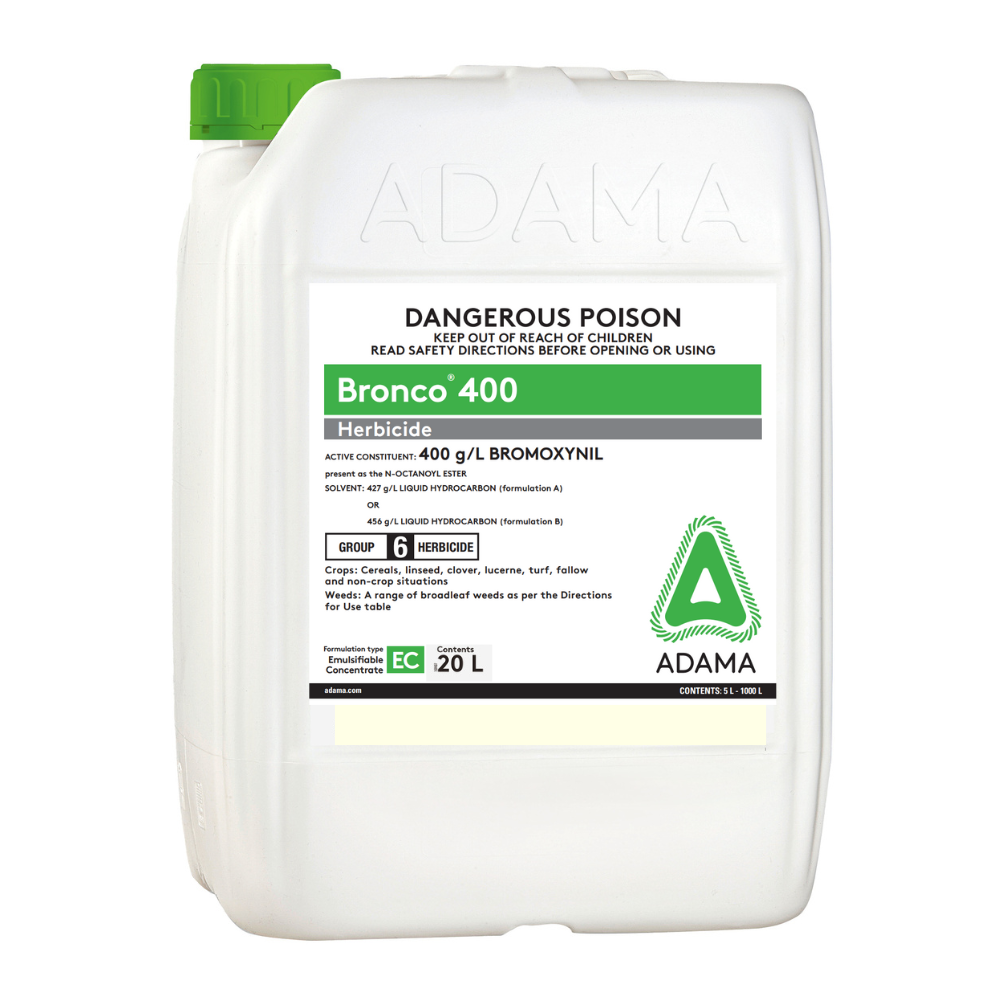
Adama Bronco 400 20L. Bromoxynil

Group 6 Herbicide
Bronco 400 Herbicide is a selective broadleaf herbicide containing 400 g/L Bromoxynil, designed for use in cereals, linseed, clover, lucerne pastures, turf, fallow, and non-crop areas. It is a Group 6 herbicide that works by inhibiting photosynthesis in target weeds. The product effectively controls a wide range of broadleaf weeds, including capeweed, wild radish, turnip weed, wireweed, and thistles. It is rainfast within three hours and can be applied via boom spraying, aerial spraying, or knapsack application. With a withholding period of 8 weeks for grazing and stock food, Bronco 400 ensures effective weed control when applied at the correct growth stage and recommended rates.
Key Features:
-
Controls a wide range of broadleaf weeds in cereals, linseed, clover, lucerne, turf, fallow, and non-crop areas.
-
Contains 400 g/L Bromoxynil as the active ingredient.
-
Classified as a Group 6 herbicide, inhibiting photosystem II in weeds.
-
Formulated as an emulsifiable concentrate (EC) for easy mixing and application.
-
Effective on young, actively growing weeds.
-
Rainfast within three hours after application.
-
Can be applied using boom sprayers, aerial application, and knapsack spraying.
-
Compatible with selected herbicides for broader weed control.
-
Withholding period of 8 weeks for grazing and stock food.
-
Does not affect cereal crop growth when used according to label directions.
Maximising Performance:
-
Apply to young, actively growing weeds for best results.
-
Ensure full coverage of weed foliage using the correct water volume.
-
Avoid application in hot, dry, or waterlogged conditions.
-
Do not apply if rain is expected within three hours to prevent wash-off.
-
Use higher rates for larger or dense weed infestations.
-
Follow proper tank-mixing procedures when combining with other herbicides.
-
Avoid spraying in windy conditions to reduce drift onto non-target crops.
-
Use a minimum of 50 L per hectare for cereals and at least 500 L per hectare for turf.
-
Regularly monitor treated areas for weed regrowth and apply follow-up treatments if needed.
Weeds Controlled:
Bronco 400 Herbicide is effective in controlling a variety of broadleaf weeds in cereals, linseed, clover, lucerne pastures, turf, fallow, and non-crop areas. Below are the weeds controlled, categorized by weed type, along with their scientific names.
Broadleaf Weeds
-
Amsinckia (Amsinckia spp.)
-
Capeweed (Arctotheca calendula)
-
Chamomile (Matricaria matricarioides)
-
Common Peppercress (Lepidium africanum)
-
Corn Gromwell (Buglossoides arvensis)
-
Fat Hen (Chenopodium album)
-
Field Madder (Sherardia arvensis)
-
Lesser Swinecress (Coronopus didymus)
-
Mountain Sorrel (Oxalis acetosella)
-
Purple Calandrinia (Calandrinia menziesii)
-
Saffron Thistle (Carthamus lanatus)
-
Shepherd’s Purse (Capsella bursa-pastoris)
-
Tree Hogweed (Polygonum patulum)
-
Turnip Weed (Rapistrum rugosum)
-
Wild Radish (Raphanus raphanistrum)
-
Wild Mustard (Sisymbrium spp.)
-
Wild Turnip (Brassica tournefortii)
-
Wireweed (Polygonum aviculare)
Vining and Climbing Weeds
-
Black Bindweed (Fallopia convolvulus)
-
Three-Horned Bedstraw (Galium tricornutum)
Thistles and Spiny Weeds
-
Three-Cornered Jack (Doublegee) (Emex australis)
-
Variegated Thistle (Silybum marianum)
Poisonous and Noxious Weeds
-
Paterson’s Curse (Echium plantagineum)
-
Mexican Poppy (Argemone ochroleuca)
-
Fumitories (Fumaria spp.)
-
Pheasant’s Eye (Adonis microcarpa)
-
Fireweed (Senecio spp.)
SHORT DESCRIPTION
Bronco 400 Herbicide is a selective broadleaf herbicide containing 400 g/L Bromoxynil, designed for use in cereals, linseed, clover, lucerne pastures, turf, fallow, and non-crop areas. It is a Group 6 herbicide that works by inhibiting photosynthesis in target weeds. The product effectively controls a wide range of broadleaf weeds, including capeweed, wild radish, turnip weed, wireweed, and thistles. It is rainfast within three hours and can be applied via boom spraying, aerial spraying, or knapsack application. With a withholding period of 8 weeks for grazing and stock food, Bronco 400 ensures effective weed control when applied at the correct growth stage and recommended rates.
ACTIVE INGREDIENTS
400 g/L BROMOXYNIL present as the N-OCTANOYL ESTER
APPLICATION INFORMATION
Application Information and Rates
Application Methods
Bronco 400 Herbicide can be applied using boom spraying, aerial application, and knapsack spraying. It is registered for use in cereals, linseed, clover, lucerne pastures, lotus, turf, fallow, and non-crop areas such as roadsides and rights-of-way.
Restraints
Do not apply using mister machines.
Do not apply if crops or weeds are stressed due to dry or excessively wet conditions.
Do not apply to diseased or frost-affected crops or turf, or if frost is imminent.
Do not apply if rain is expected within three hours.
Do not apply to lucerne crops, clover-based pastures, or turf in temperatures above 20°C.
Do not apply with smaller than a coarse spray droplet size category.
Spray Drift Restraints
Do not allow bystanders to come into contact with the spray cloud.
Do not apply if wind speed is outside 3 to 20 km/h.
Do not apply if hazardous surface temperature inversion conditions exist.
Crop Stages for Application
Wheat, barley, cereal rye, oats, and triticale - Apply from the three-leaf stage to fully tillered stage (Z13-30).
Linseed - Apply when plants are between 50 to 150 mm high.
Lucerne and clover - Apply after seedlings have developed at least one trifoliate leaf or before regrowth reaches 150 mm in established stands.
Lotus - Apply at least four weeks after sowing when seedlings have two to six true leaves.
Application Rates for Boom Spraying
For wheat, barley, cereal rye, oats, and triticale, apply between 50 to 200 L of water per hectare.
For linseed, apply a minimum of 220 L of water per hectare.
For turf applications, apply 3.0 L per 500 L of water per hectare.
For knapsack spraying, mix 30 mL per 100 square meters in 10 to 15 L of water.
Application Rates for Aerial Spraying
Apply a minimum of 22 L of water per hectare.
Use appropriate droplet sizes and avoid spraying under conditions that may lead to drift.
Withholding Periods
Do not graze treated crops or cut for stock food for 8 weeks after application.
No withholding period is required for crop harvest when used as directed.
Mixing Instructions
Fill the spray tank at least 70 percent full with water and start agitation.
Add products in this order: wettable powders, water-dispersible granules, suspension concentrates, emulsifiable concentrates, then soluble liquids.
Compatibility
Compatible with Adama 2,4-D Amine 625, Adama MCPA 750, and diclofop-methyl for ryegrass and wild oat control.
Do not mix with 2,4-D or MCPA if the crop is undersown with lucerne, clover, or medics.
WEEDS CONTROLLED
Weeds Controlled
Bronco 400 Herbicide is effective in controlling a variety of broadleaf weeds in cereals, linseed, clover, lucerne pastures, turf, fallow, and non-crop areas. Below are the weeds controlled, categorized by weed type, along with their scientific names.
Broadleaf Weeds
Amsinckia - Amsinckia spp.
Capeweed - Arctotheca calendula
Chamomile - Matricaria matricarioides
Common Peppercress - Lepidium africanum
Corn Gromwell - Buglossoides arvensis
Fat Hen - Chenopodium album
Field Madder - Sherardia arvensis
Lesser Swinecress - Coronopus didymus
Mountain Sorrel - Oxalis acetosella
Purple Calandrinia - Calandrinia menziesii
Saffron Thistle - Carthamus lanatus
Shepherd’s Purse - Capsella bursa-pastoris
Tree Hogweed - Polygonum patulum
Turnip Weed - Rapistrum rugosum
Wild Radish - Raphanus raphanistrum
Wild Mustard - Sisymbrium spp.
Wild Turnip - Brassica tournefortii
Wireweed - Polygonum aviculare
Vining and Climbing Weeds
Black Bindweed - Fallopia convolvulus
Three-Horned Bedstraw - Galium tricornutum
Thistles and Spiny Weeds
Three-Cornered Jack (Doublegee) - Emex australis
Variegated Thistle - Silybum marianum
Poisonous and Noxious Weeds
Paterson’s Curse - Echium plantagineum
Mexican Poppy - Argemone ochroleuca
Fumitories - Fumaria spp.
Pheasant’s Eye - Adonis microcarpa
Fireweed - Senecio spp.
PRODUCT LABEL SUMMARY
Herbicide Label Summary
APVMA Approval No: 80801/RV2024
Product Name: Bronco 400 Herbicide
Active Constituent: 400 g/L Bromoxynil (present as the N-Octanoyl Ester)
Solvent: 427 g/L Liquid Hydrocarbon (Formulation A) or 456 g/L Liquid Hydrocarbon (Formulation B)
Herbicide Group: Group 6 Herbicide
Formulation Type: Emulsifiable Concentrate (EC)
Registered Use: Control of broadleaf weeds in cereals, linseed, clover, lucerne, turf, fallow, and non-crop situations
Poison and Safety Warnings
Dangerous Poison
Keep out of reach of children
Read safety directions before opening or using
Directions for Use
Restraints
Do not apply using mister machines.
Do not apply if crops or weeds are stressed due to dry or excessively wet conditions.
Do not apply to diseased or frost-affected crops or turf, or if frost is imminent.
Do not apply when rain is expected within 3 hours.
Do not apply to lucerne crops, clover-based pastures, or turf in temperatures above 20°C.
Do not apply with smaller than a coarse spray droplet size category.
Spray Drift Restraints
Do not allow bystanders to come into contact with the spray cloud.
Do not apply if wind speed is outside 3 to 20 km/h.
Do not apply if hazardous surface temperature inversion conditions exist.
Crops and Situations
Approved Crops: Wheat, barley, cereal rye, oats, triticale, linseed, clover, lucerne pastures, lotus seed and forage crops, turf
Non-Crop Areas: Fallow, roadsides, and rights-of-way
Weeds Controlled
Amsinckia - Amsinckia spp.
Black Bindweed - Fallopia convolvulus
Capeweed - Arctotheca calendula
Chamomile - Matricaria matricarioides
Common Peppercress - Lepidium africanum
Corn Gromwell - Buglossoides arvensis
Fat Hen - Chenopodium album
Field Madder - Sherardia arvensis
Lesser Swinecress - Coronopus didymus
Mountain Sorrel - Oxalis acetosella
Purple Calandrinia - Calandrinia menziesii
Saffron Thistle - Carthamus lanatus
Shepherd’s Purse - Capsella bursa-pastoris
Three-Horned Bedstraw - Gallium tricornutum
Tree Hogweed - Polygonum patulum
Variegated Thistle - Silybum marianum
Mexican Poppy - Argemone ochroleuca
Three-cornered Jack - Emex australis
Turnip Weed - Rapistrum rugosum
Wild Radish - Raphanus raphanistrum
Wild Mustard - Sisymbrium spp.
Wild Turnip - Brassica tournefortii
Wireweed - Polygonum aviculare
Paterson’s Curse - Echium plantagineum
Fumitories - Fumaria spp.
Pheasant’s Eye - Adonis microcarpa
Fireweed - Senecio spp.
Application Information and Rates
Crop Stage
Wheat, barley, cereal rye, oats, and triticale: Apply from 3-leaf to fully tillered stage (Z13-30).
Linseed: Apply when plants are 50-150 mm high.
Lucerne and clover: Apply after seedlings have one trifoliate leaf or before 150 mm regrowth in established stands.
Lotus: Apply at least 4 weeks after sowing when seedlings have 2-6 true leaves.
Application Methods
Boom spraying: Use a minimum of 50-200 L/ha (WA: 50-100 L/ha).
Aerial application: Minimum of 22 L/ha.
Turf: 3.0 L per 500 L of water per hectare or 30 mL per 100 m² with knapsack spraying.
Withholding Periods
Not required for crop harvest when used as directed.
Do not graze treated crops or cut for stock food for 8 weeks after application.
General Instructions
Mixing Instructions
Fill the spray tank at least 70% full with water and start agitation.
Add products in this order: wettable powders, water-dispersible granules, suspension concentrates, emulsifiable concentrates, then soluble liquids.
Compatibility
Compatible with Adama 2,4-D Amine 625, Adama MCPA 750, and diclofop-methyl for ryegrass and wild oat control.
Do not mix with 2,4-D or MCPA if undersown with lucerne, clover, or medics.
Resistant Weeds Warning
Bronco 400 is a Group 6 herbicide (Photosystem II inhibitor).
Some naturally resistant weed biotypes may exist and could dominate if the product is used repeatedly.
Safety and Protection
Re-Entry Period
Do not enter treated areas until the spray has dried unless wearing protective clothing.
Protection of Crops and Non-Target Plants
Do not spray under conditions that may cause drift onto susceptible crops.
Application in temperatures above 20°C may cause damage to seedlings and established plants.
Protection of Livestock
Low hazard to bees; may be applied as per directions.
Protection of Wildlife and Environment
Dangerous to fish; do not contaminate streams, rivers, or watercourses.
Storage and Disposal
Store in a locked area away from children, animals, food, and feedstuffs.
Do not store for prolonged periods in direct sunlight.
Triple rinse containers before disposal or return to designated collection points.
Large refillable containers must be returned to the supplier.
Safety Directions
Poisonous if inhaled or swallowed.
May irritate the eyes and skin; avoid contact and inhalation of spray mist.
Wear protective gloves and face shield when preparing the spray.
Wash hands, arms, and face after handling.
First Aid
If poisoning occurs, contact a doctor or Poisons Information Centre (Australia: 13 11 26).
If swallowed, do not induce vomiting—give a glass of water.
Additional Information
SDS is available at adama.com or by calling 1800 423 262.
Manufacturer provides no warranty on suitability beyond label directions.
LABEL, SDS & TECH SHEET
SHIPPING & RETURNS
Greenway Weed Solutions has a distribution centre in QLD only. All orders, Australia-wide will be shipped from this location.
Shipping is free on all online orders. Bulk purchase shipping rates are determined by total order weight and delivery location.
Pickups are available from the QLD warehouse. Updates to product availability in other Australian warehouses are upcoming.
Choose options
explore our latest Blogs

Developing Outcome-Based Vegetation Management Specifications
Many vegetation management contracts fail because they specify activities rather than the asset outcome to be achieved. Prescribing three spray rounds or two mowing cycles does not guarantee safe r...
Read more
Herbicide Resistance Management for Infrastructure Assets
Herbicide resistance is one of the most significant long term risks facing vegetation management. Left unmanaged, it can reduce treatment options, increase operational costs and compromise the effe...
Read more
Vegetation Risk Assessment for Critical Infrastructure
Vegetation risk assessment provides a structured process for identifying, evaluating and managing vegetation that may affect the safety, reliability or performance of critical infrastructure. Rathe...
Read more